Bitcoin is a payment network with no operator, whose native unit is issued on a fixed schedule that every participant independently enforces and that stops permanently at 21 million coins.
What it is
Bitcoin is two things wearing one name. It is a network of computers that agree, without anyone in charge, on the order of a list of transactions. And it is the unit that list keeps track of, which is also called bitcoin, conventionally with a lowercase b when you mean the coin and an uppercase B when you mean the system.
What makes it worth a record of its own is not the payments part. Plenty of things move value. It is the issuance rule. Bitcoin's supply schedule was set in 2009 and has not been altered since, and the reason it has not been altered is structural rather than a matter of anyone's good behaviour. That distinction — a rule enforced by everyone versus a promise made by someone — is the thing to take away from this page.
The four numbers
- Maximum supply
- 21 million BTC. Bitcoin's own documentation says issuance halts completely at that figure.
- Issued so far
- A little over 20 million, read from public block explorers in August 2026. Check a current explorer rather than trusting this line six months from now.
- Block subsidy today
- 3.125 BTC per block, the fifth step of the schedule.
- Halving interval
- Every 210,000 blocks, a constant in Bitcoin Core's consensus parameters.
Who builds it
Nobody owns Bitcoin, which sounds like marketing and is actually an inconvenient operational fact. There is no company, no foundation with authority over the protocol, and no legal entity that can be compelled to change it.
What exists instead is a set of overlapping groups. Bitcoin Core is the dominant node implementation, maintained as an open-source project with a contributor base that changes over time and a conservative review culture. Alternative implementations exist and a few are used in production. Miners run the hardware that orders transactions. Exchanges, custodians and wallet providers decide which rules their software follows. Businesses build on top.
Changing a consensus rule requires enough of those groups to adopt incompatible software at roughly the same time. That is why the supply cap has held: not because anyone promised, but because the coordination cost of breaking it is enormous and the people who would have to cooperate mostly do not want to.
The original author published under the name Satoshi Nakamoto and stopped participating in 2011. This record does not speculate about who that was. It is not a fact about how the token works.
The time the coordination cost was tested
All of that sounds theoretical until you look at what happened in 2017, which is the closest thing Bitcoin has to a controlled experiment on who actually decides its rules.
A long-running argument about increasing the block size came to a head. A significant coalition of miners and businesses supported a larger block; a large part of the node-running and developer community did not. The dispute ended in a chain split: the larger-block version continued as a separate network with its own ticker, and the original ruleset kept the name, the ticker and, decisively, the economic majority.
The instructive part is which group turned out to be load-bearing. It was not the miners, who mostly followed the market rather than leading it, and it was not the businesses. It was the people running nodes and choosing which rules to enforce, because a block that breaks the rules your node checks is simply not a block as far as you are concerned.
That is the mechanism behind “the cap holds because coordination is expensive”, and it has been demonstrated once under real pressure rather than only argued.
How the token works
New bitcoin enters existence exactly one way: as the block subsidy paid to whoever produces a valid block. Nothing else creates it. There is no minting function, no treasury allocation, no team wallet.
The subsidy started at 50 BTC per block. Every 210,000 blocks it halves. At Bitcoin's target of one block every ten minutes, that works out at roughly every four years, though the real interval drifts with hash rate — blocks have been running a little under ten minutes on average, so halvings arrive slightly early.
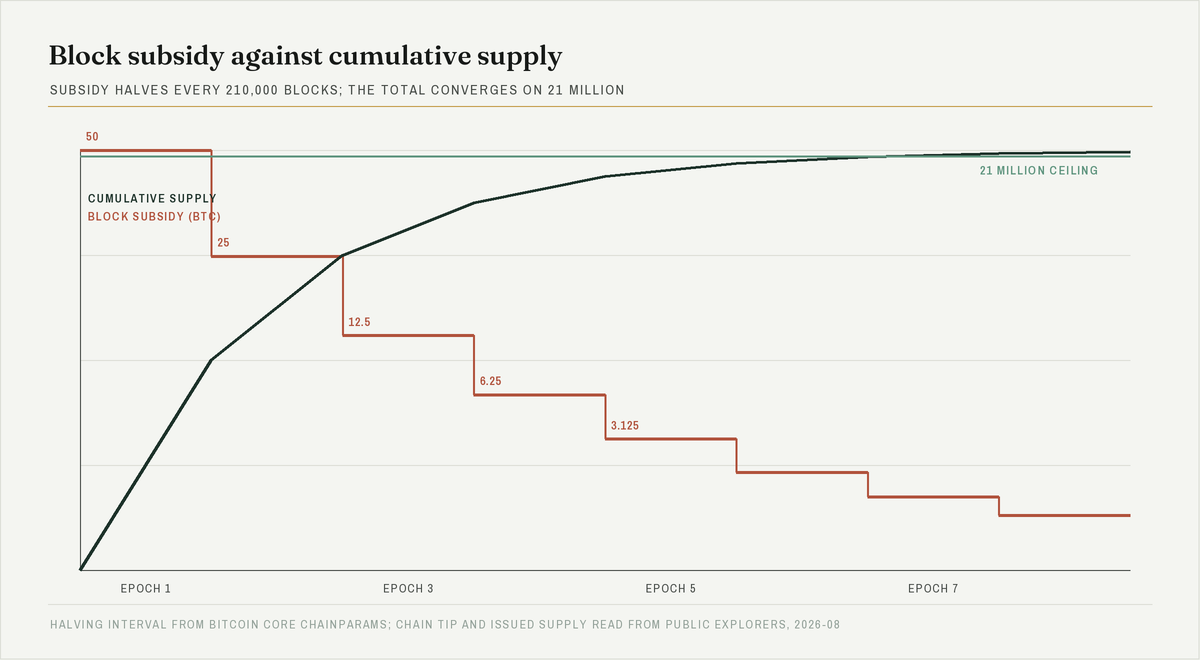
The chart above is the whole tokenomics story in one image, and it has a property most people miss. Because each step is half the last one and the interval stays constant, the first four steps issued about 94% of everything that will ever exist. Bitcoin's supply expansion is, for practical purposes, already over. What remains is a very long tail that finishes somewhere around 2140.
Two consequences follow. First, the phrase “bitcoin is scarce” is doing less work than people think — the scarcity was mostly achieved a decade ago. Second, and more interestingly, the subsidy that pays for network security is on a permanent decline.
The part that is genuinely unresolved
Miners earn two things: the subsidy and the transaction fees in the block they produce. Right now the subsidy is the larger component by a wide margin. Every halving shifts that balance, and by the 2030s the subsidy will be small enough that fees have to carry most of the load.
Bitcoin's own FAQ addresses this directly, saying miners “will probably be supported exclusively by numerous small transaction fees” once issuance ends. That word probably is carrying real weight. Whether a fee market alone will fund enough hashing to keep the chain expensive to attack is an open question, and anyone who tells you they know the answer is guessing. It is not a reason to avoid bitcoin or to buy it. It is simply the largest genuinely unanswered question about the design, and a record that skipped it would be incomplete.
What it is actually used for
Design and practice have drifted apart here, and it is worth being straight about it.
The 2008 paper describes a peer-to-peer electronic cash system. Bitcoin can do that, and in some places it is genuinely used that way. But the dominant use in 2026 is holding — as a balance sheet asset, as collateral, as the settlement layer under exchange-traded products, and as a store of value by people who distrust local currency arrangements. On-chain payments for ordinary retail purchases are a small share of activity.
Several things pushed it that way. Base-layer capacity is deliberately limited, so fees rise when demand does, which makes small payments unattractive. Confirmation takes minutes rather than seconds. Price volatility makes it awkward as a unit of account. And once institutions could hold it through regulated products, a lot of demand arrived that was never going to spend it.
Payment use has largely moved a layer up, onto systems that settle to the base chain periodically rather than per transaction. That is a real and growing use, but it is a different thing from paying on chain, and it comes with its own trade-offs around liquidity and being online.
Risk checklist
Facts, not scores. Read them as things to be aware of, not as a verdict.
- The security budget declines by design. The subsidy halves on a schedule regardless of whether fee revenue grows to replace it. This is the structural issue with no settled answer.
- Mining is concentrated. A small number of pools coordinate a large share of hash rate. Pools do not own the hardware and participants can leave, but the coordination points exist.
- Fees are unpredictable. Block space is fixed, so cost is set by competition for it. A busy period can make a small transaction uneconomic with no warning.
- Settlement is probabilistic. There is no finality event. Confidence grows with confirmations rather than arriving at a defined moment.
- Custody errors are permanent. A lost key is a lost balance. There is no recovery process, because there is nobody to run one.
- Regulatory treatment varies and changes. Tax and reporting rules differ by country and have been revised repeatedly.
Where to buy
Bitcoin trades on essentially every centralised exchange, in a wide range of quote currencies, and is one of the few assets where liquidity is rarely the constraint. It is also available through regulated exchange-traded products in several markets, which is a different thing from holding the coin: you own a claim on a fund, not a key.
If you are buying the coin itself, the thing to check before you place an order is which quote currency the pair uses, since buying against a currency you do not hold means an extra conversion. Whether you leave the coins on the exchange afterwards or move them to your own wallet is a genuine trade-off, not an obvious choice, and it is covered properly in the guide on actually buying a first coin.
Checking all of this yourself
Everything on this page is verifiable in about five minutes, and doing it once is the fastest way to stop needing to trust pages like this one.
The halving interval. Open Bitcoin Core's repository and find the mainnet consensus
parameters. The value nSubsidyHalvingInterval is set to 210000 there. That is not a claim
about Bitcoin; it is the rule the software enforces.
The current subsidy. Take the chain height from any block explorer and divide by 210,000. The whole-number part is how many halvings have completed. Halve 50 that many times. At a height above 840,000 and below 1,050,000, that arithmetic gives 3.125 BTC, which is where the network is now.
How much has been issued. Several explorers publish the total in circulation directly, denominated in satoshis. Divide by 100,000,000 for a figure in bitcoin. Read it yourself rather than taking the number from an article, including this one — that is exactly the correction that was made to this page before publication, and it is logged on the corrections page.
When the next halving falls. Subtract the current height from 1,050,000 and multiply by ten minutes. That gives an estimate, not a date, because real block intervals run slightly under the target and the difficulty adjustment only corrects the drift every two weeks. Anyone quoting a precise day is quoting an estimate with false confidence.
Questions people actually ask
Can the 21 million limit be changed?
Only if the people running the software agree to run different software. The cap is enforced by every full node checking every block, so changing it means persuading node operators, miners, exchanges and wallets to adopt an incompatible rule at the same time. Nothing prevents that in principle; in practice it has never come close.
What happens to miners when the subsidy reaches zero?
Bitcoin's own FAQ says miners will probably be supported by transaction fees alone. That transition is already under way: every halving makes the subsidy a smaller share of what a miner earns. Whether fees alone will pay for enough security is a genuinely open question and nobody can answer it from current data.
Have all 21 million bitcoin been created yet?
No. As of August 2026 a little over 20 million had been issued, leaving under a million to be released over roughly the next century. The tail is long because each halving cuts the rate in half while the interval between halvings stays the same.
Supply cap and the fee-transition wording taken from bitcoin.org's FAQ; the 210,000-block halving interval and ten-minute target from Bitcoin Core's mainnet consensus parameters; chain height and issued supply read from mempool.space in August 2026. If you need a current number rather than a magnitude, take it from an explorer, not from here.
Related: how to read a supply and emission schedule · supply structure table · the record for a coin with no cap at all