Chainlink is a network of independent node operators that publish off-chain data onto blockchains, and LINK is the token those operators are paid in for doing it.
The short version
- Total supply is capped at one billion LINK. No issuance mechanism creates more.
- It is an ERC-677 token, which is ERC-20 plus the ability to carry a data payload.
- Its documented role is compensation to node operators for services delivered.
- It is also used for staking, which backs service quality with capital at risk.
- Separating that working demand from holding demand is the analytical question here.
What it is
Smart contracts cannot see outside their own chain. A contract that needs to know the price of an asset, whether a shipment arrived, or what a random number is has no way to find out on its own. Feeding it that information is the oracle problem, and it is harder than it sounds, because whoever supplies the data can also manipulate whatever depends on it.
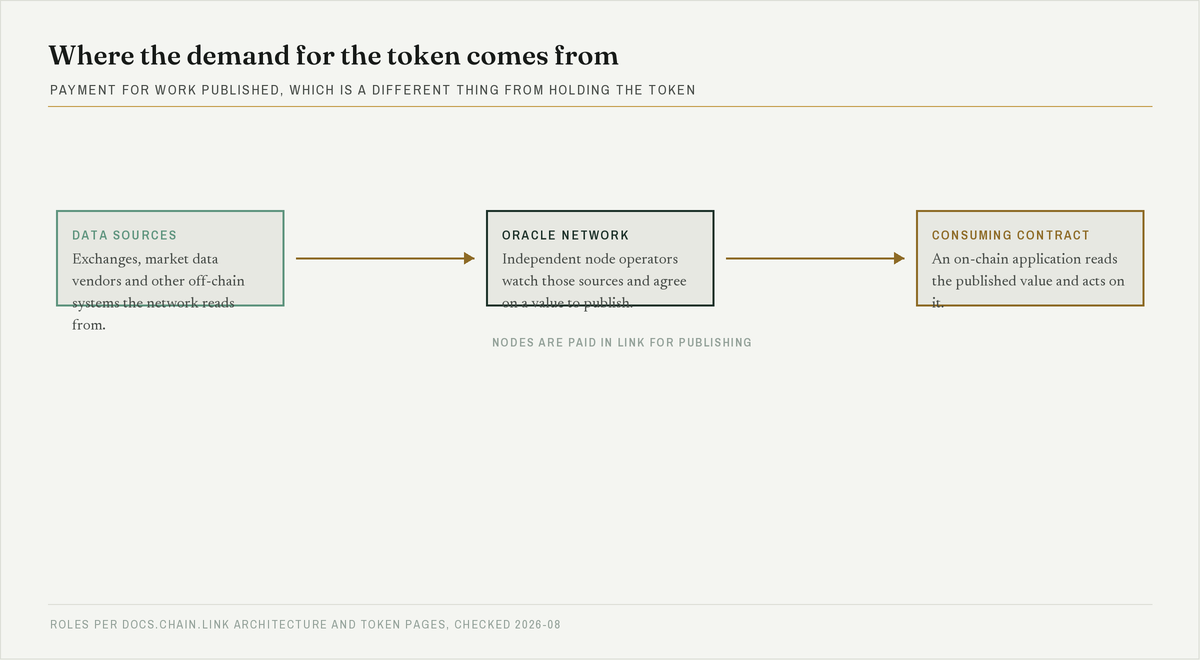
Chainlink's approach is to use multiple independent node operators. Each watches the relevant sources, each submits a value, and the network aggregates their answers into one published result. Corrupting the output requires corrupting enough operators simultaneously, which is meant to be harder than corrupting one.
Chainlink is not a blockchain. It is a set of contracts and off-chain software running across many chains at once.
Who builds it
Chainlink Labs is the company that develops the protocol and coordinates the ecosystem, founded by Sergey Nazarov and Steve Ellis after the 2017 whitepaper and token sale.
Node operators are separate parties — a mix of professional infrastructure firms, some traditional data providers, and independent operators. They run the software, stake reputation and, increasingly, capital, and are paid for the services they deliver.
The division matters: Chainlink Labs writes the code and does business development, but the entities actually publishing data are third parties. Whether that set is diverse enough is a fair question and one you can partly answer by looking at the operator lists on individual feeds.
How the token works
LINK's supply is simple. One billion tokens, an ERC-677 contract, eighteen decimals, no issuance mechanism. The interesting part is not the schedule; it is what creates demand.
Payment for work
Chainlink's documentation describes LINK as “the standard unit of compensation to network service providers, such as node operators, for successfully facilitating Chainlink services.” That is a specific claim: operators are paid in LINK for delivered work.
The ERC-677 standard is not incidental. It allows a transfer to carry data, so a single transaction can both pay a contract and tell it what to do — a request and its payment in one step, rather than the approve-then-call dance an ordinary ERC-20 requires.
Staking
Chainlink staking lets participants lock LINK behind the performance of specific services. The point is to put capital at risk against the reliability of the data, so that a node operator who misbehaves or underperforms faces a financial consequence rather than only a reputational one. Stakers earn rewards; this is one of the significant non-payment sinks for the token.
The part that is genuinely hard to pin down
Here is the honest position, and this record would be less useful without it.
Data feeds do not update on every price change. Chainlink's own documentation explains that updates trigger on a deviation threshold — the value moved enough to matter — or a heartbeat — enough time has passed. This is a sensible engineering design that avoids paying for updates nobody needs. It also means the number of paid publications is not a simple function of how much the network is used.
On top of that, the ecosystem has developed payment arrangements that let services be paid for in assets other than LINK, with conversion happening behind the scenes. Those arrangements make adoption easier and make the relationship between usage and LINK demand less direct.
So: LINK unambiguously has a working role, which is more than can be said for many tokens. Quantifying how much of the demand for it comes from that role versus from people holding it is not something you can settle from public data, and this record does not pretend otherwise. What it can tell you is what to look at: published operator payments, staking participation, and how much of the fee flow is denominated in LINK rather than converted into it.
What it is actually used for
The dominant real use is price feeds for decentralised finance. Lending protocols need to know when collateral has fallen below a threshold; derivatives need a settlement price; stablecoins need to know what their collateral is worth. A large share of the value locked in on-chain finance depends on a Chainlink feed somewhere in its stack, which makes this infrastructure with genuine load rather than a demonstration.
Beyond price feeds: verifiable randomness for applications that need an unriggable draw, automation that triggers contract functions on conditions, cross-chain messaging, and proof-of-reserve feeds that publish attested backing figures on chain.
There is also a body of work connecting traditional financial infrastructure to on-chain settlement, which has produced pilots with established institutions. Pilots are pilots; this record notes their existence without treating them as revenue.
Risk checklist
- Data quality is upstream. The network aggregates sources. If the underlying sources are wrong in a correlated way, aggregation does not fix it.
- Operator set concentration. Individual feeds are secured by a specific set of operators, and those sets are not always large. Look at the feed, not at the network average.
- Update thresholds are a design parameter. Between updates, a feed reports its last value. Applications that assume continuous accuracy are misusing it, and this has caused losses.
- Token demand is indirect. Payment abstraction and conversion mean fee flow does not translate one-for-one into LINK demand.
- Circulating supply has grown over time. The cap is fixed, but a portion of the billion was retained at launch and has entered circulation over the years. Check the current circulating figure rather than treating the cap as the relevant number.
- Central development dependency. One company drives most protocol development and business relationships.
- It is infrastructure, so it is a target. Anything a lot of value depends on attracts attention from people trying to break it.
Where to buy
LINK is listed on all major centralised exchanges and trades on decentralised venues across the chains it is deployed to. It exists on multiple networks, so check which one you are withdrawing to.
The one billion supply figure comes from Chainlink's circulating supply page; the ERC-677 standard, the Juels denomination and the compensation wording from the LINK token documentation; the deviation and heartbeat triggers from the decentralised data model documentation. All read August 2026.
Related: reading supply and emission schedules · supply structure table · the network most of these feeds serve