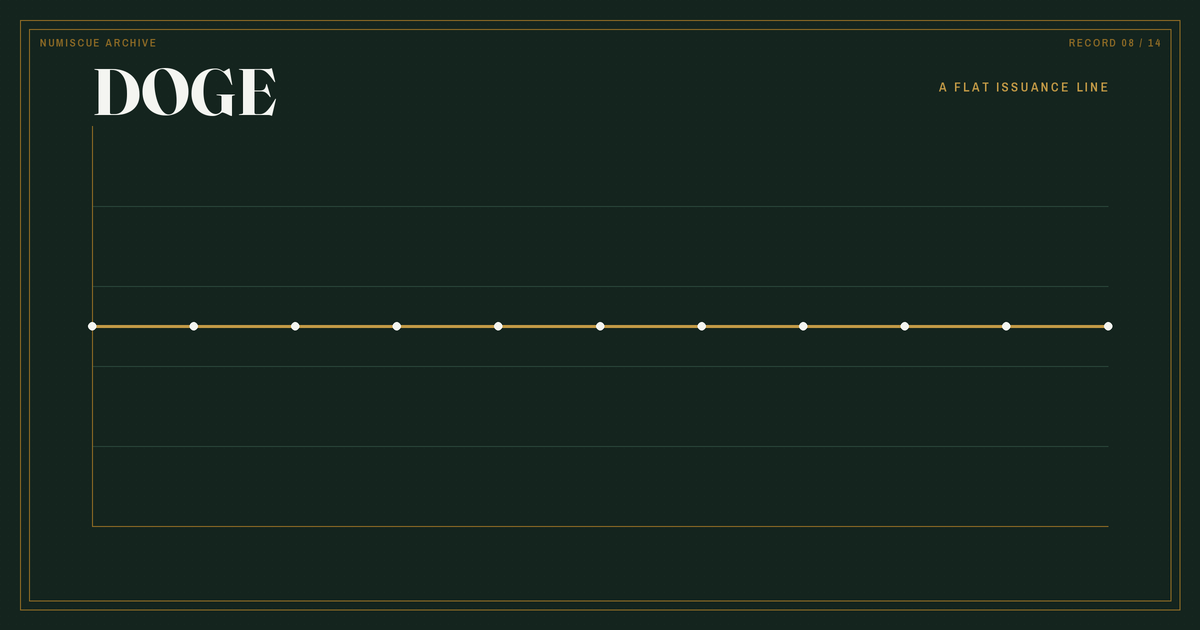
Dogecoin is a proof-of-work payment network with no maximum supply, issuing a fixed 10,000 coins per block indefinitely, which works out at roughly five billion new coins a year regardless of how many already exist.
The short version
- There is no maximum supply constant. Issuance has no end date.
- The reward halved every 100,000 blocks until block 600,000, then stopped halving at 10,000 DOGE.
- Blocks target one minute, so that is about five billion new DOGE a year, forever.
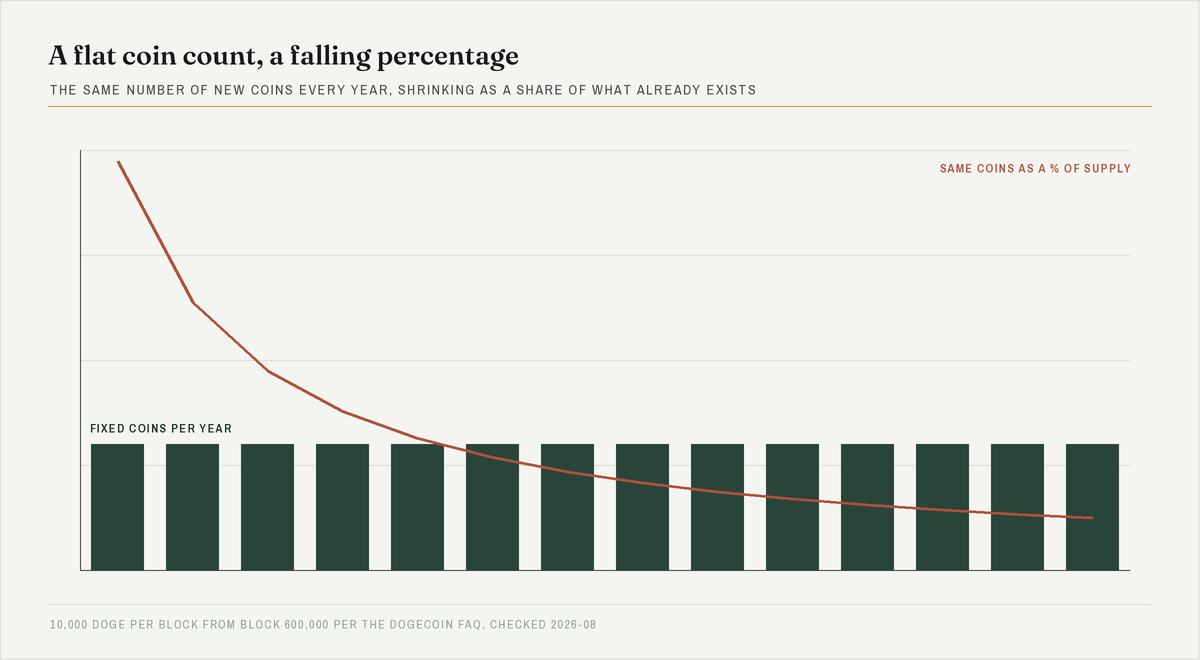
- Because the number is fixed and the total keeps growing, the percentage falls every year.
- The project's own position is that this makes supply bounded, not unlimited. Worth reading.
What it is
Dogecoin launched in December 2013 as a fork of Litecoin, itself a fork of Bitcoin, with a deliberate lack of seriousness about its own branding. The technology was not novel and was not meant to be.
What is worth a record is the monetary design, which differs from Bitcoin's in the one way that matters and is almost always glossed over. Most introductions to Dogecoin talk about the meme, the community and the celebrity attention. This page is about the issuance rule, because that is the actual difference.
Who builds it
Dogecoin was created by Billy Markus and Jackson Palmer, both of whom stepped away from the project years ago.
Development is now handled by a small group of volunteer maintainers working on the open-source Dogecoin Core repository. The Dogecoin Foundation was re-established in 2021 to support development and has published roadmaps and funded work, but it does not control consensus rules.
The maintainer group is small. That is a fact about the project's development capacity and belongs in the risk section rather than in a judgement here. Because Dogecoin shares much of its codebase lineage with Bitcoin, some upstream improvements can be adapted rather than written from scratch, which partially offsets the small team.
How the token works
Dogecoin originally had a random block reward, replaced early on with a fixed schedule. Rewards halved every 100,000 blocks, and from block 600,000 onward the reward settled at a permanent 10,000 DOGE per block.
Blocks target one minute. There are 525,600 minutes in a year. So annual issuance is roughly 5.256 billion DOGE, and it will be roughly 5.256 billion next year, and the year after, indefinitely.
The thing most introductions skip
Fixed issuance with a growing base produces a falling inflation rate without any halving mechanism at all. When 5 billion new coins land on a base of 100 billion, that is 5%. On 200 billion it is 2.5%. On 400 billion it is 1.25%. The line falls toward zero asymptotically and never reaches it.
This is a genuinely different monetary design from Bitcoin's, not a worse implementation of it. Bitcoin's supply converges on a fixed number; Dogecoin's grows without bound while its growth rate converges on zero. Which one you consider preferable depends on what you think the token is for, and this record does not have a view.
The project's own framing, which is worth reading carefully
Dogecoin's official material pushes back on the word “unlimited”. Its position is that supply is not unlimited because there is an absolute limit on issuance per block, per day and per year — Dogecoin is “only 'infinite' over 'infinite time'”, and over any finite period issuance is finite.
That is a fair point and also a narrow one. It is true that the issuance rule is fixed, so you can estimate closely how many DOGE will exist on a future date (actual block times drift around the one-minute target, so the figure is an approximation rather than an exact count), which is more than can be said for a discretionary issuer. It is also true that there is no number the supply converges on. Both things can be held at once, and a reader is better served by seeing the argument than by being handed either “infinite supply” or “actually it's bounded” as a slogan.
The stated reason for permanent issuance is security funding: a block reward that never goes to zero means miners never have to be paid by fees alone. That is a direct answer to the open question on the Bitcoin record, arrived at by accepting permanent dilution instead.
Merged mining
Since 2014 Dogecoin has been merge-mined with Litecoin, meaning miners can secure both chains with the same work. This substantially raised Dogecoin's security relative to what its own fee and reward market would support alone. It also means Dogecoin's hash rate is largely a byproduct of another network's mining economics.
What it is actually used for
Dogecoin is used for small payments, tipping and donations, in retail speculation, and by a number of merchants who accept it directly. Transfers are fast and cheap, and a coin with no fee pressure and one-minute blocks is genuinely serviceable for moving small amounts.
There is no smart contract platform, no meaningful decentralised finance ecosystem, and no staking. The chain does one thing. Whether that is a limitation or a virtue depends on what you wanted from it.
By activity, though, the dominant use is trading. Dogecoin's price history is strongly associated with public attention rather than with network usage, which is a fact about how the market treats it rather than about the protocol.
Risk checklist
- Permanent dilution. Roughly five billion new coins a year, indefinitely, going to miners. As a fraction it shrinks; in absolute terms it does not.
- Security depends on another chain's economics. Merged mining with Litecoin supplies most of the hash rate. Changes in Litecoin's mining economics affect Dogecoin's security without anything changing on Dogecoin.
- Small development team. A handful of volunteer maintainers on a chain with significant market value is a concentration of both capability and single points of failure.
- Holdings are concentrated. A small number of addresses hold a large share of supply, which is publicly observable on chain.
- Price is attention-driven. Historical price movements have tracked public commentary more closely than any network metric. That is a statement about observed behaviour, not a forecast.
- No hedge against protocol stagnation. Development is slow by design and by resource. Features other chains have added are not coming quickly here.
Where to buy
Dogecoin is listed on nearly every major centralised exchange and is one of the more widely available assets in this archive. Withdrawals go to a standard Dogecoin address, and the network's low fees mean moving it off an exchange is rarely expensive.
Questions people actually ask
Does Dogecoin have a maximum supply?
There is no maximum supply constant in the protocol. Issuance continues at a fixed rate per block with no end date. The Dogecoin project's own position is that this does not make supply unlimited, because the amount issued per block, per day and per year is strictly bounded.
How many new DOGE are created each year?
The block reward has been a fixed 10,000 DOGE since block 600,000, and blocks target roughly one minute, which works out at about five billion DOGE a year. That figure does not change as the total supply grows.
Could a cap be added later?
It would require a consensus rule change adopted across nodes, miners and services. The project has publicly argued against it, on the grounds that continuous issuance is what pays miners once fees alone would not.
The halving schedule and the permanent 10,000 DOGE reward from block 600,000 are stated in the FAQ in the Dogecoin repository; the project's argument about bounded issuance is quoted from its Dogepedia entry on capping supply. Both read August 2026. The annual figure is arithmetic from the block reward and block target, not a measured number.
The repository’s block reward rule was rechecked on 16 October 2026. Estimates by calendar date use the one-minute block target, not a guaranteed block count.
Related: the fixed-cap comparison · reading supply and emission schedules · supply structure table