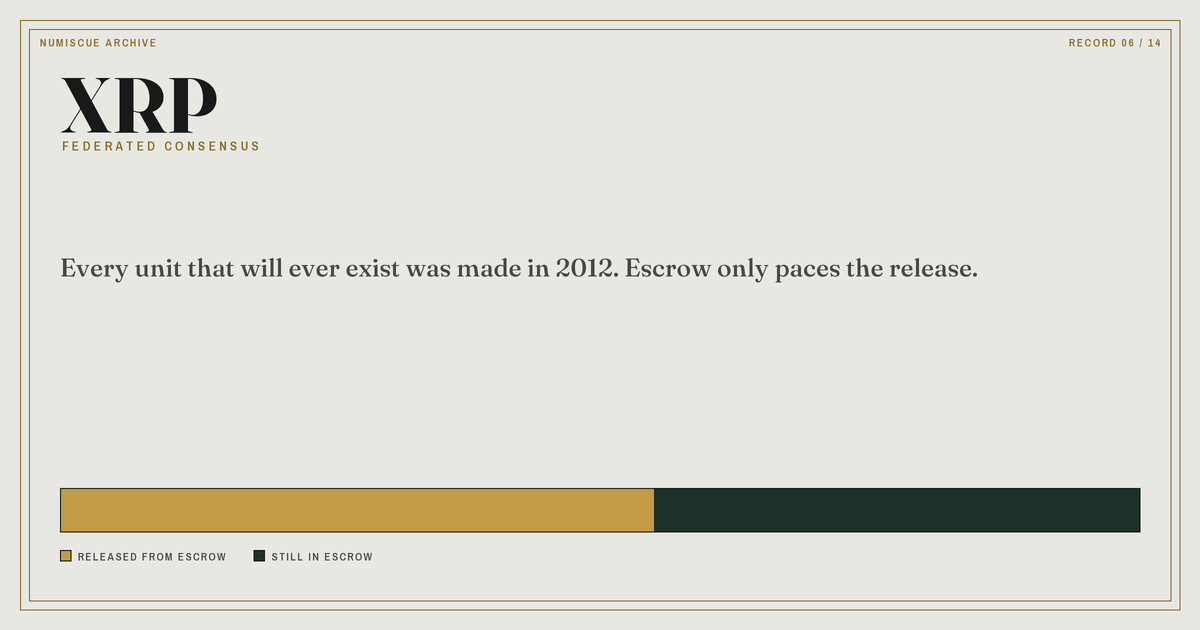
XRP is the native asset of the XRP Ledger, of which 100 billion units were created at once when the ledger launched, with no mechanism to create more and a small amount destroyed by every transaction.
The short version
- All 100 billion XRP existed on day one. Nothing mines or mints it.
- In 2017, Ripple put 55 billion into 55 escrow contracts, one expiring each month.
- Whatever is not used in a month goes back into a new contract at the end of the queue.
- So escrow paces market access. It does not change how much exists.
- Every transaction destroys a small amount of XRP, so total supply drifts slowly downward.
What it is
The XRP Ledger is a payment network that settles in a few seconds using a consensus process quite unlike proof of work or proof of stake. Instead of competing for the right to produce a block, validators each keep a list of other validators they trust not to collude, and the network reaches agreement through overlapping trust lists.
XRP is its native asset. It pays the transaction cost, it meets the ledger's account reserve requirements, and it can serve as a bridge asset between two currencies that have no direct market.
The ledger was built over 2011 and early 2012 by Jed McCaleb, Arthur Britto and David Schwartz. At creation there were 100 billion XRP. That number is the beginning and the end of the issuance story: there is no subsidy, no staking reward, no inflation schedule.
Who builds it
Two layers again, and as with BNB the boundary is worth being precise about.
The XRP Ledger is open-source software with an independent validator set. Anyone can run a validator; there is no stake requirement and validators are not paid. Trust list composition determines who actually influences consensus, and while Ripple publishes a recommended list, it is a recommendation rather than a control.
Ripple is a private company, the largest single holder of XRP, and the main commercial developer building payment products on the ledger. Of the original 100 billion, the 2012 allocation put 80 billion with Ripple and 20 billion with the founders.
The XRP Ledger Foundation exists as an independent non-profit supporting the protocol.
How the token works
The escrow, in detail
In 2017 Ripple placed 55 billion XRP into escrow on the ledger itself. The structure was not one big lock — it was 55 separate contracts of one billion each, expiring on the first day of successive months.
Each month, one billion becomes available. Ripple uses some of it, historically for institutional sales and for incentives to market makers. Whatever is not used goes into a new escrow contract placed at the back of the queue. So if 300 million is used in a given month, 700 million returns to escrow with an expiry beyond the original 55-month horizon.
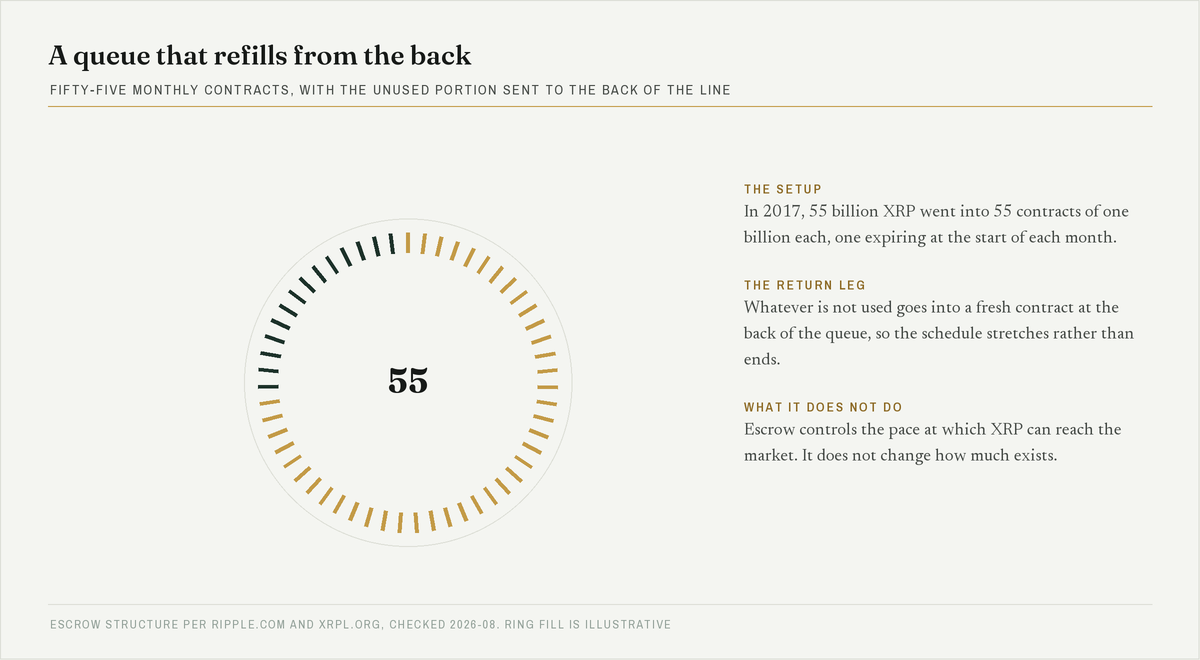
The consequence is that the schedule stretches rather than ending. It has run well past its original 55 months precisely because much of each release went back in.
What escrow does and does not do
It puts a ceiling on how much of Ripple's holding can reach the market in a given month, and it does so with a mechanism anyone can verify on the ledger rather than with a promise. That is a genuine transparency improvement over an unlocked corporate treasury.
What it does not do is reduce the total. The XRP in escrow exists, is counted in total supply, and will eventually be released on some schedule. Treating escrowed XRP as if it were burned is a misreading, and it is the same class of error as confusing circulating supply with total supply — covered in the guide on reading supply schedules.
The transaction cost is destroyed
Every XRP Ledger transaction must destroy a small amount of XRP. The documentation is unambiguous about it: the cost “is not paid to any party: the XRP is irrevocably destroyed.” The reference minimum for a standard transaction is 10 drops — a drop being one millionth of an XRP — and it rises automatically when the network is under load.
The purpose is anti-spam rather than monetary: making an attack expensive. But the side effect is that total supply is very slowly deflationary, at a rate driven entirely by usage. At current volumes the effect on 100 billion units is small.
The reserve requirement, which surprises small holders
One more supply-adjacent mechanism, and the one most likely to affect you directly if you hold XRP in your own account rather than on an exchange.
Every account on the XRP Ledger must hold a base reserve in XRP before it exists at all, plus an additional owner reserve for each object it owns — a trust line, an offer on the built-in exchange, an escrow. Those amounts are not spendable while the account or object exists.
Two practical consequences. An account cannot be created by sending it less than the base reserve; the transaction simply fails. And a balance is never entirely available, because some of it is holding the account open.
The reserve amounts are set by validator consensus and have been lowered over time as the cost of running the ledger fell. They are parameters rather than constants, so check the current values on the ledger rather than assuming a figure from an article.
What it is actually used for
The design case is cross-border payments: convert currency A into XRP, move it in seconds, convert into currency B, avoiding pre-funded accounts in every destination market.
In practice that use exists but is a modest share of activity. Ripple has built products around it and has institutional customers, though not all of Ripple's payment products require XRP as a bridge asset at all — some route through other rails. The distinction between “a company using the ledger” and “a company using the token” is one this record has to draw carefully, because promotional material about the former is frequently read as evidence of the latter.
The ledger also carries a decentralised exchange, issued tokens including several stablecoins, and NFT functionality. And a material share of XRP activity is what it is for most assets in this archive: trading and holding.
Risk checklist
- Holdings are concentrated. A large share of total supply sits with the company and in escrow. That concentration is verifiable on-ledger, which is better than opaque, but it is still concentration.
- Escrow releases are scheduled and ongoing. A billion XRP becomes available monthly. How much reaches the market depends on decisions made each month.
- Validator selection depends on trust lists. Consensus security rests on validators choosing overlapping, non-colluding lists. The default recommended list has an influence that a permissionless staking set does not.
- No validator rewards. Validators are unpaid, so the set depends on parties with independent reasons to run one. That avoids some incentive problems and creates a different one.
- Legal status has been the subject of litigation. The classification of XRP under US securities law has been contested in court, with rulings that distinguished between different types of sale. Outcomes vary by jurisdiction and by transaction type. This record states that the proceedings exist and does not characterise their result, which is a matter for legal sources rather than a coin archive.
- Account reserves lock small balances. Every account must hold a base reserve, plus more for each object it owns. Small holders should know their balance is not entirely spendable.
Where to buy
XRP is listed on most large centralised exchanges, though availability has varied by jurisdiction over the years for regulatory reasons and is worth checking rather than assuming. It also trades on the XRP Ledger's own built-in decentralised exchange.
If you withdraw to a self-custodied XRP Ledger account, note two things: the account must be funded with at least the base reserve before it exists at all, and many exchanges require a destination tag on deposits. Sending without one is a common cause of delayed or lost credits.
The 100 billion creation figure and the 2012 allocation come from XRPL's own introduction to XRP; the escrow structure from Ripple's escrow announcement; the destroyed transaction cost and the 10-drop reference from the transaction cost documentation. All read August 2026.
Related: the unlock calendar, where this schedule appears · supply structure table · another asset with a scheduled release from a pot