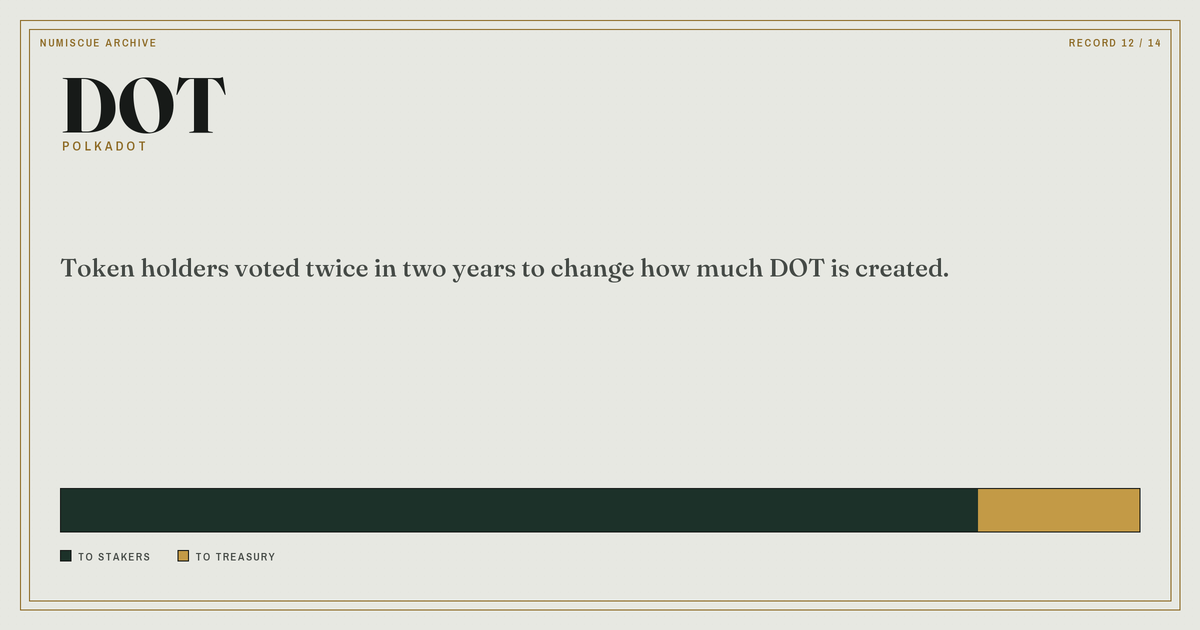
Polkadot is a proof-of-stake network in which most of the token supply is bonded to validators, withdrawal takes 28 days, and the rate at which new DOT is created is decided by on-chain votes rather than fixed at launch.
| Question | Answer | Source |
|---|---|---|
| Unbonding period | 28 days, being 28 eras of 24 hours | Polkadot wiki chain state values |
| Era length | 24 hours | Same |
| Split of new issuance | 85% to stakers, 15% to the on-chain treasury | Polkadot wiki, DOT token page |
| Minimum to nominate directly | A few hundred DOT, and it moves with competition | Same — check the live value |
| Minimum via a nomination pool | One DOT | Same |
What it is
Polkadot is a network designed to run other blockchains. A central relay chain provides shared security and messaging, and separate chains connect to it and inherit that security instead of bootstrapping their own validator set.
The model for how connected chains get access to the relay chain has evolved considerably. It began with parachain slots won at auction and locked for fixed periods; it has since moved toward a more flexible arrangement in which blockspace is purchased more like a commodity. If you read older material about two-year parachain leases, that describes a system that has been substantially reworked.
DOT is the relay chain's token: staked to secure it, used to vote, and used to pay for the blockspace connected chains consume.
Who builds it
Polkadot came out of work by Gavin Wood, a co-founder of Ethereum. The Web3 Foundation supports the protocol and funds research; Parity Technologies is the principal software developer.
What distinguishes Polkadot from most networks in this archive is that its governance is on-chain and binding. Token holders vote on referenda, and a passed referendum executes automatically as a runtime upgrade — no coordinated client release, no waiting for operators to adopt anything. The chain changes itself.
That is the direct cause of the issuance history below, and it is the reason this record cannot give you a single tidy inflation number.
How the token works
The staking side
DOT is bonded to nominate validators, and a very large share of supply is bonded at any time. Stakers receive most of new issuance. Validators that misbehave are slashed, which puts nominators' bonded DOT at risk too — nominating is not a passive yield product, it is backing a specific operator.
The 28-day unbonding period is the fact with the most practical consequence. Once you begin unbonding, the DOT earns nothing and cannot be moved for four weeks. It exists so that slashing can still reach a validator that tries to exit after misbehaving, which is a sound reason. It also means that a large fraction of the token's supply is, at any moment, four weeks away from being sellable. Anyone reasoning about liquidity should hold that thought.
Nomination pools exist for holders below the direct minimum, allowing participation from one DOT, with the same unbonding wait.
The issuance side, which has moved twice
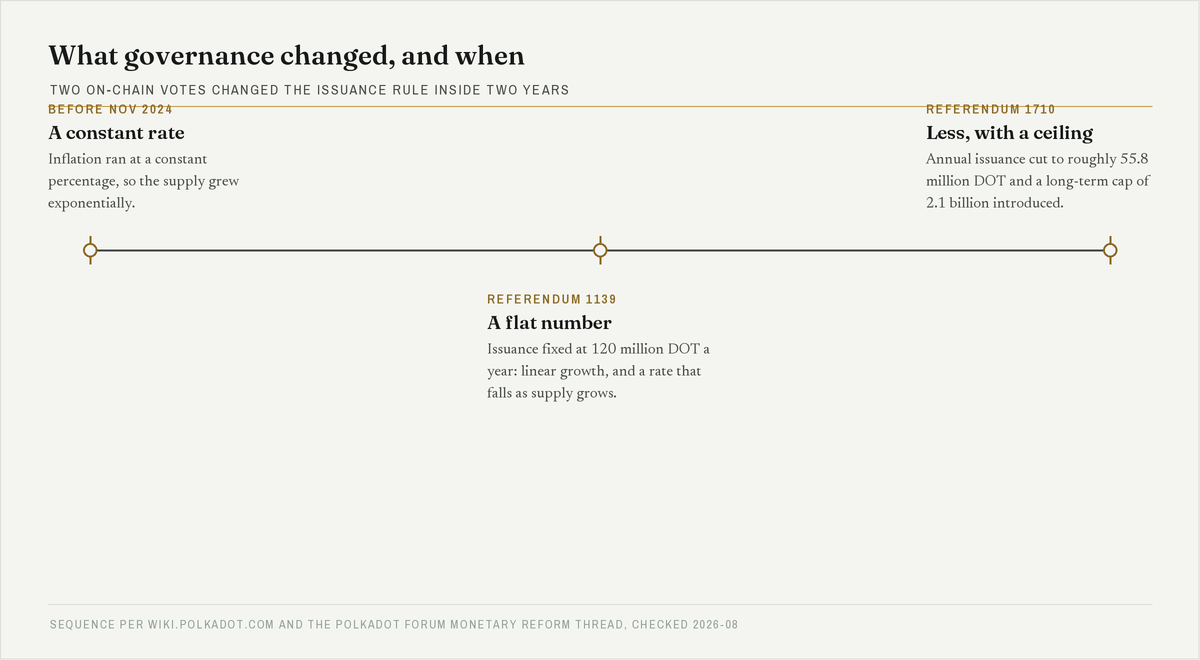
Until November 2024, Polkadot ran a constant inflation rate, which produces exponential supply growth.
Referendum 1139 replaced that with a fixed annual amount: 120 million DOT a year, split 85% to stakers and 15% to the treasury. Fixing the number rather than the rate turns exponential growth into linear growth and makes the percentage fall automatically as supply rises — the same arithmetic that governs Dogecoin's declining inflation, adopted deliberately here rather than inherited from a fork.
Referendum 1710 then reduced annual issuance again, to roughly 55.8 million DOT, and introduced a long-term supply ceiling of 2.1 billion DOT. The stated aim was to reduce the network's dependence on inflationary funding in favour of actual protocol revenue.
Reading the current model alongside the older projection
The DOT wiki now distinguishes the stepped schedule introduced by Referendum 1710 from the earlier 120 million DOT annual model. Its older fixed-rate projection is explicitly marked as historical. Read that distinction before treating an annual amount as current.
Polkadot's issuance can change through governance. For the current schedule, start with the wiki's updated inflation section and its linked chain explorers, then check the latest enacted referendum. A forum discussion provides context rather than a live supply reading.
What binding on-chain governance actually means
The phrase gets used loosely across the industry, so it is worth being precise about what is different here.
On most networks, a governance vote is a signal. Token holders express a preference, and then a separate set of people — developers, node operators, exchanges — decide whether to implement it. The vote has no mechanical force; it has social force, which is not nothing but is not the same thing.
On Polkadot, a passed referendum executes. The runtime is stored on chain, and an approved proposal replaces it at a scheduled block. Nobody has to agree afterwards. Nobody has to ship a release. There is no window in which operators can decline.
The consequences run both ways, and a record should state both.
It removes a coordination problem. Changes that take other networks a year of negotiation can happen on a defined timetable. The issuance changes described above went through in exactly this way.
It concentrates decisions into turnout. Referenda pass on the votes cast, and turnout is typically a modest fraction of supply. A change with real economic consequences can be decided by an engaged minority — not through any irregularity, simply because most holders do not vote.
It makes the token's economics a moving target. If issuance is a governance parameter, then any projection of future supply is a projection about future votes. That is a genuinely different risk profile from a fixed schedule, and it is neither better nor worse in the abstract.
What it is actually used for
Staking, by a wide margin. Most DOT is bonded.
After that: governance participation, which on Polkadot is unusually consequential given that referenda execute automatically; treasury funding, since 15% of issuance flows to a pot that referenda spend on ecosystem work; and paying for blockspace for connected chains.
Application-level activity on the relay chain itself is limited by design — the relay chain does not run smart contracts. Activity lives on connected chains, and the health of the ecosystem is better read from those than from the relay chain.
Risk checklist
- Monetary policy can change by vote. Twice in two years. Any long-range supply projection depends on future referenda that have not happened.
- 28-day exit. Bonded DOT is four weeks from liquidity. That is a constraint on holders and a structural feature of the supply available to trade.
- Nominators are exposed to slashing. Backing a validator that misbehaves can cost you principal, not just rewards.
- Governance participation is uneven. Turnout on referenda is typically a small fraction of supply, so decisions with real economic consequences can be made by a modest share of holders.
- Documentation drift. Official pages currently disagree about the issuance regime, and one carries an unmaintained warning. That is a real problem for anyone trying to verify facts.
- The connection model has been reworked. Projects that built around the original parachain auction system have had to adapt. Architectural change of that scale carries execution risk.
- Development concentration. A small number of organisations do most of the core engineering.
Where to buy
DOT is listed on major centralised exchanges. If you plan to stake, decide first whether you are nominating directly or joining a nomination pool, since the minimums differ by orders of magnitude and the direct minimum moves with competition.
Whichever you choose, budget for the 28-day exit before you commit. Funds locked for four weeks are easy to overlook when you stake.
The 28 days, and what has grown around them
A four-week exit is a strong constraint, and predictably a market has grown up to work around it. Liquid staking arrangements issue a transferable token representing a staked position, so you can sell the position immediately even though the underlying DOT is still bonded.
That solves the liquidity problem by moving it. Worth being clear about what you hold in that case:
- You hold a claim, not the DOT. Its value depends on the arrangement working and on someone wanting to buy it.
- The price can drift from par. In a rush for the exit, a liquid staking token trades at whatever the market will pay, which can be below the value of the underlying — because the buyer is the one who ends up waiting 28 days.
- The slashing risk is still yours. Wrapping a staked position does not remove exposure to the validator misbehaving.
- You have added a smart contract. The wrapper is code, and code is a risk surface the underlying protocol does not have.
None of that makes liquid staking a bad idea. It makes it a different position with different failure modes, and the useful mental model is that the unbonding period did not disappear — somebody is still waiting it out, and the price you get reflects who.
Questions people actually ask
How long does it take to unstake DOT?
Twenty-eight days. The unbonding period runs for 28 eras of 24 hours each, during which the DOT earns nothing and cannot be transferred. It exists so that misbehaviour can still be punished after a validator tries to withdraw.
How much DOT is created each year?
Referendum 1139 introduced a fixed 120 million DOT annual model; Referendum 1710 introduced a stepped schedule and a 2.1 billion DOT ceiling. The wiki distinguishes that schedule from its historical 120 million projection. Use its current-model section and linked explorers for current data.
Where does the newly issued DOT go?
Under the post-2024 model it splits 85% to stakers and 15% to the on-chain treasury, which funds work approved by referendum.
The 28-day unbonding period, era length and staking minimums come from the Polkadot wiki's chain state values; the Referendum 1139 regime and the 85/15 split from the DOT token page; the Referendum 1710 reduction and the 2.1 billion ceiling from the Polkadot forum thread on completing the monetary reform. All read August 2026. The official sources describe different stages of the reform; a historical projection is not the current schedule.
The DOT wiki was rechecked on 16 October 2026: it identifies the stepped schedule and labels the older 120 million projection as historical. The forum thread is background discussion, not live chain-state data.
Related: consensus mechanisms compared · reading supply and emission schedules · another network with an on-chain treasury