Cardano is a proof-of-stake network with a maximum supply of 45 billion ADA, whose new coins come not from issuance in the usual sense but from a fixed reserve that pays out a fraction of what remains in it every epoch.
The eras, and what shipped in each
- Byron
- Mainnet launch in 2017, federated block production.
- Shelley
- Decentralised block production and delegated staking, from 2020.
- Goguen
- Smart contracts through Plutus, from 2021.
- Basho
- Scaling and performance work, delivered incrementally rather than as one event.
- Voltaire
- On-chain governance, activated at the Chang hard fork in 2024.
What it is
Cardano is a proof-of-stake blockchain whose consensus protocol, Ouroboros, was developed through peer-reviewed academic research before implementation. That sequence — formal specification and publication first, code second — is the project's distinguishing characteristic, and it explains both its reputation for rigour and its reputation for being slow.
It uses an extended unspent-transaction-output accounting model rather than the account model used by Ethereum and its relatives. Contracts are written in Plutus. Time is divided into epochs of five days, which is the unit that governs staking rewards and reserve payouts.
ADA is the native token: staked, used for fees, and required as a minimum balance alongside any tokens an address holds.
Who builds it
Three organisations have historically shared the work. Input Output, formerly IOHK, does core engineering and research. The Cardano Foundation, based in Switzerland, handles standards, adoption and stewardship. Emurgo focuses on commercial ventures.
Since the Voltaire era activated, on-chain governance has added a fourth layer: delegated representatives elected by ADA holders, a constitutional committee, and stake pool operators, who together vote on protocol changes and treasury spending under a ratified constitution.
Block production is handled by stake pool operators, of whom there are many — Cardano's pool count is among the highest of any network here, and the reward formula is designed to discourage stake concentrating in a small number of very large pools.
How the token works
The maximum supply is 45 billion ADA. All of it was created at genesis, and it sits in three places: in circulation, in the treasury, and in a reserve that has not yet been released.
The reserve, which is the mechanism
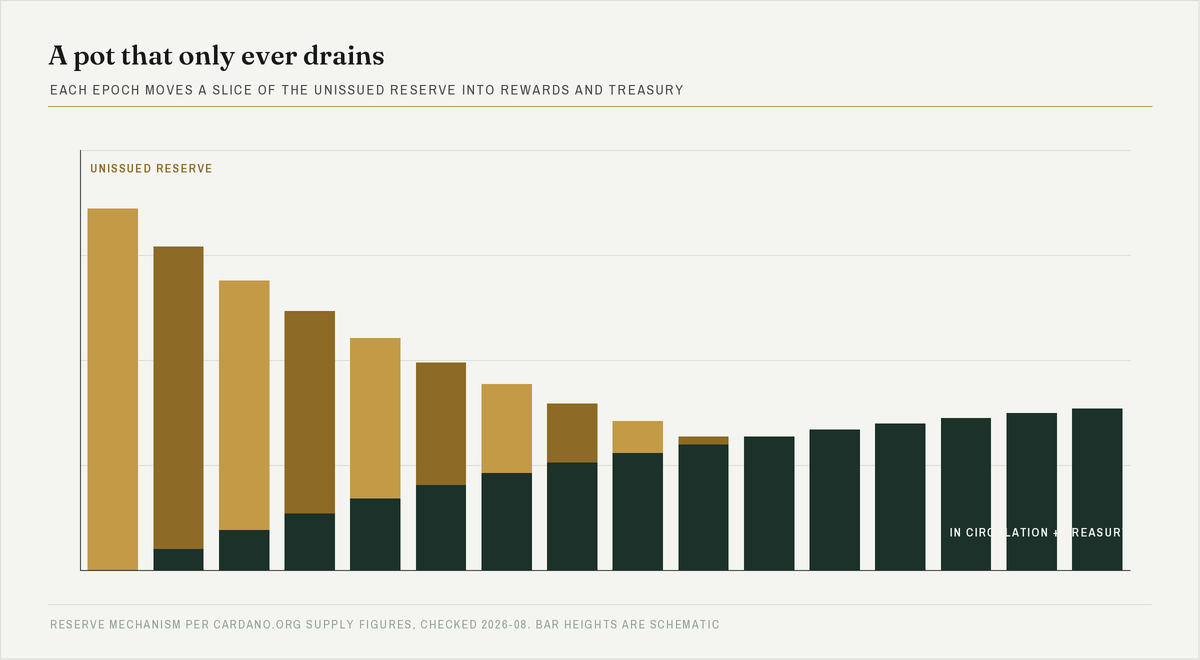
Every epoch, a fixed percentage of the remaining reserve is released. Part of that release goes to the treasury and the rest is distributed as staking rewards, alongside the transaction fees collected during the epoch.
Taking a constant fraction of a shrinking pot produces a decaying series: large payouts early, smaller ones later, approaching zero without ever reaching it. Which means ADA's effective inflation rate falls automatically over time, with no halving event and no governance vote required. It is the same mathematical shape as Solana's disinflation curve, arrived at through a completely different mechanism — Solana decays a rate, Cardano decays a balance.
One consequence people find counter-intuitive: staking rewards decline over time by design, and the decline is not a sign of anything going wrong. As reserve payouts shrink, a larger share of rewards has to come from transaction fees, which is the same long-run transition Bitcoin faces — arriving here without a hard stop.
What Cardano publishes
Cardano publishes its supply breakdown per epoch on chain: circulating, treasury, reserve. That is unusually direct compared with projects where you have to reconstruct the numbers. If you want current figures, take them from that dashboard rather than from any article, this one included.
Minimum ADA per address
Because Cardano's accounting model attaches tokens to outputs, every address holding tokens must also hold a minimum amount of ADA. Holders of Cardano-native tokens should know that a small ADA balance is locked as a consequence, and cannot be spent away.
What it is actually used for
Staking dominates. Cardano's staking participation is high, and the design makes it unusually frictionless: there is no lock-up and no unbonding period. Delegated ADA remains liquid and spendable at all times, which is a meaningful difference from Polkadot's 28-day wait.
Beyond that: a decentralised finance ecosystem including lending and decentralised exchanges, Cardano-native tokens that do not require smart contracts to create, NFTs, and identity and supply-chain work in several developing markets, some of which has been pursued through partnerships.
Governance is now a live use as well. Delegating voting power to a representative is a distinct action from delegating stake, and both exist.
Relative to the network's market prominence, on-chain financial activity is modest. That is an observation about measured usage, not a judgement about the engineering.
Risk checklist
This section lists what has and has not happened. It does not rate the pace of delivery, which is an argument rather than a fact.
- Staking rewards decline structurally. The reserve mechanism guarantees smaller payouts over time. Fees must grow to compensate.
- Fee revenue is currently small. Rewards depend substantially on the reserve, and the reserve is finite.
- The contract model is unfamiliar. The extended UTXO model and Plutus require different patterns from EVM development, which narrows the developer pool and the library of audited code.
- Governance is new. On-chain governance activated in 2024 and its institutions are still establishing precedent. New governance systems are where unexpected outcomes come from.
- Development is concentrated. A small number of organisations do most of the core work, although the governance changes are intended to broaden that.
- Ecosystem scale. Measured on-chain financial activity is smaller than for several networks of comparable prominence.
- Minimum ADA lock-up. Holding native tokens requires locking a small ADA balance per address.
Where to buy
ADA is listed on all major centralised exchanges. Withdrawals go to a Cardano address, and if you intend to stake, note that delegation happens from your own wallet without giving up custody and without locking the balance.
The 45 billion maximum supply and the reserve, treasury and circulating breakdown come from Cardano's own supply dashboard, which publishes per-epoch figures; era names and what each delivered from Cardano's documentation. Read August 2026. Current supply figures move every epoch and are deliberately not reproduced here.
Related: a staking model with a very different exit · consensus mechanisms compared · reading supply and emission schedules