USDC is a dollar-referenced token issued by Circle, backed mainly by a government money market fund registered with the SEC and managed by BlackRock, with the remainder held as cash at large banks and a monthly attestation from a Big Four firm.
| USDC | USDT | |
|---|---|---|
| Issuer | Circle, a US-headquartered company | Tether Holdings and related entities |
| Main reserve vehicle | Circle Reserve Fund, an SEC-registered 2a-7 government money market fund managed by BlackRock | A reserve pool managed by the issuer, composition published quarterly |
| Reporting cadence | Monthly third-party assurance, weekly holdings disclosure | Quarterly assurance opinion |
| Report type | Attestation, to AICPA attestation standards | Assurance opinion on a reserves report |
| Entity auditor | Deloitte & Touche LLP audits Circle's financial statements — a separate engagement from the reserve attestation | Not disclosed as a financial statement audit |
Structures per each issuer's own transparency material, checked August 2026. This is a structural comparison, not a ranking.
What it is
USDC is the same category of instrument as USDT: a token on a blockchain representing a claim that its issuer says is backed one-for-one by reserves. The peg is identical. The plumbing behind it is not, and this record exists to lay out those differences without turning them into a scoreboard.
The reason the differences matter is that a dollar-referenced token can only fail through its structure. The token contract almost never breaks. What breaks is the reserve, the issuer, or the route between you and either of them. So the structure is the risk profile.
Who builds it
Circle Internet Group issues USDC. It is a US-headquartered company, publicly listed, which means it files financial statements and is audited as an entity by Deloitte & Touche LLP.
That last point deserves care, because it is exactly the sort of thing that gets garbled. Circle's financial statement audit and USDC's reserve attestation are two different engagements. The audit covers the company's accounts. The attestation covers whether reserves exceeded tokens in issue. Neither substitutes for the other, and having both is a different position from having one.
USDC was originally launched through a consortium arrangement that included Coinbase. That structure has since been reorganised, and Circle is now the issuer. Coinbase retains a commercial relationship around USDC distribution.
How the token works
As with USDT, there is no emission schedule. Tokens are minted when a customer deposits with the issuer and burned when redeemed. Supply is a function of demand, not of a curve.
Where the reserves sit
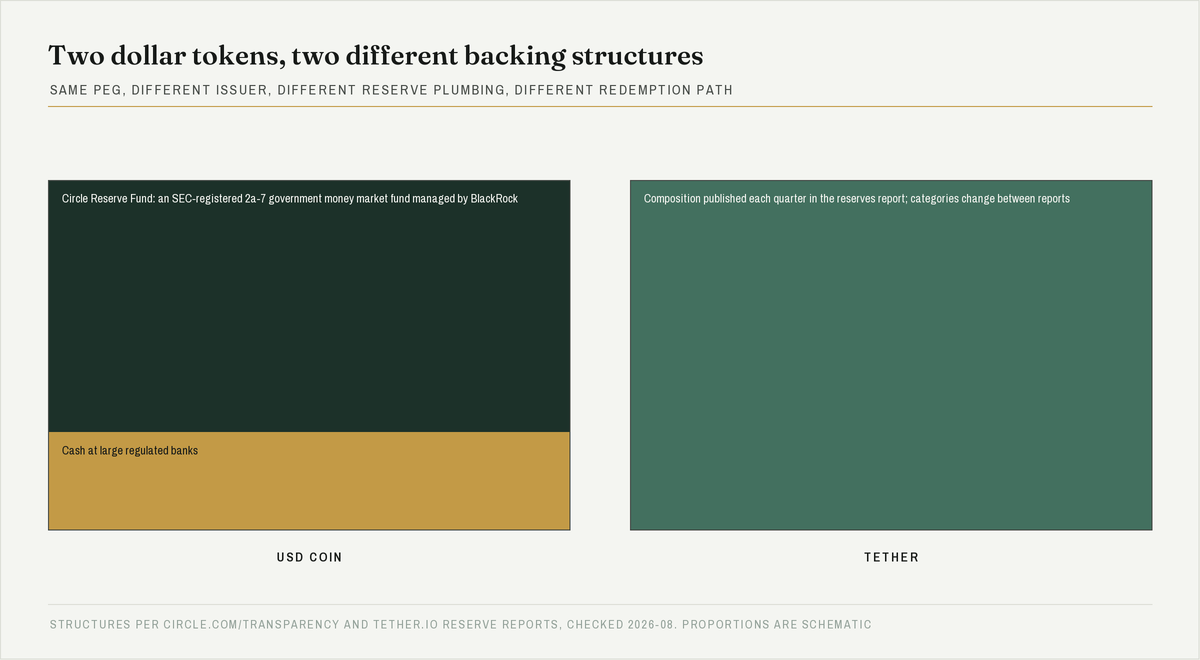
Circle states that the majority of USDC reserves are held in the Circle Reserve Fund, which trades under the ticker USDXX. Three things about that vehicle are worth understanding:
- It is a money market fund registered with the SEC under rule 2a-7, which constrains what it may hold and how it must report.
- It is managed by BlackRock, a third-party asset manager, rather than by Circle.
- Its holdings are cash, short-dated US Treasuries and overnight Treasury repurchase agreements — the shortest-duration, most liquid end of government paper.
The rest is held as cash deposits at a small number of large banks, segregated from Circle's own operating funds.
What the reporting covers
Circle publishes a monthly attestation in which a Big Four accounting firm provides third-party assurance that the value of USDC reserves exceeded the amount of USDC in circulation, prepared under attestation standards set by the AICPA. Holdings are also disclosed weekly.
Note that this is still an attestation, not an audit of the reserves. Monthly is more frequent than quarterly and the reserve vehicle is a regulated fund with its own reporting, so there is more visible information than for some alternatives. It remains a report on a position as at a date.
The redemption path
This is the difference people notice least and should notice most. A stablecoin's peg holds in normal markets because arbitrage works: if the token trades below a dollar, somebody buys it cheaply and redeems it at par. That only functions if redemption is actually available to enough participants.
Circle operates an account-based mint and redeem service for eligible customers, subject to onboarding and verification. Most ordinary holders never touch it and exit through an exchange instead — which means, in practice, that they depend on the market rather than the reserve. The redemption channel matters even to people who never use it, because it is what makes the arbitrage work at all.
March 2023, in more detail
This episode is the most instructive thing that has happened to a large fiat-reserved stablecoin, and it is worth walking through rather than summarising, because every step demonstrates something the structure sections above only assert.
A portion of USDC's reserves was held as cash deposits at a US bank. That bank failed. The exposure was disclosed, and over a weekend USDC traded meaningfully below a dollar on secondary markets.
Four things happened at once, and separating them is the lesson.
- The token contract worked perfectly. Nothing on chain broke. Transfers settled normally throughout. The failure was entirely off chain, in the reserve.
- Redemption was not available to most holders, and in any case the mint and redeem facility was constrained over a weekend when banking rails were closed. The arbitrage that normally restores a peg had no route to run.
- The price was therefore set by the order book, and the order book was people guessing at the recovery rate on a bank deposit with no information. That is what the discount actually was: not a measurement of the reserve, a measurement of uncertainty about it.
- The deposits were made whole and the peg restored within days.
What it demonstrates, cleanly: the backing protects the instrument, and market liquidity protects you, and those are different things. A holder who could redeem was never at risk of more than a delay. A holder who could only sell was exposed to whatever the market thought, for as long as the market thought it.
It also demonstrates that “held as cash at a bank” is a credit position rather than the absence of one, which is a distinction that reads as pedantic right up until the moment it does not.
What it is actually used for
USDC's usage skews differently from USDT's. It is more prominent in decentralised finance protocols as collateral and as a settlement asset, more common in payments and treasury contexts involving regulated businesses, and more used in North America and Europe. USDT dominates in exchange quote pairs and in regions where informal dollar access matters.
USDC also appears natively on a growing number of chains, issued directly by Circle on each rather than bridged, which reduces one category of transfer risk.
Risk checklist
- Bank exposure is real and has been tested. In March 2023, USDC briefly traded below a dollar after a portion of reserves was disclosed as held at a bank that failed. The exposure was recovered, but the episode is the clearest available demonstration that cash at a bank is a credit position, not an absence of risk.
- Issuer credit risk. The token is Circle's obligation. Regulation and an entity audit change the shape of that exposure and the amount you can see about it. They do not remove it.
- Attestation, not reserve audit. Monthly assurance on a stated position is more frequent reporting, but it is the same category of document as a quarterly one.
- Balances can be frozen. The issuer can block specific addresses and has done so.
- Redemption is gated. Direct redemption requires an eligible account. Everyone else depends on secondary market liquidity.
- Regulatory dependence. Circle's model is built around operating inside regulatory frameworks, which is a strength when those frameworks are stable and a dependency when they change.
- Chain confusion. Native USDC on one chain is not the same balance as bridged USDC on another. Check before withdrawing.
Where to buy
USDC is available on major centralised exchanges and widely across decentralised venues. In several markets it can be obtained directly from an exchange with a bank transfer, which is often the cleanest route in and out.
As with any multi-chain token, decide which network you want it on before you move it.
Native and bridged, and why the difference matters here
USDC has a wrinkle that most multi-chain tokens do not, and it is worth understanding before you hold it anywhere other than Ethereum.
On some networks, Circle issues USDC directly. That is native USDC: the contract is the issuer's, and the token is redeemable through the normal route.
On others, USDC arrived by being locked on one chain and represented on another. That is bridged USDC. It tracks the price of the real thing because the lock exists and the bridge behaves, and it carries the bridge's risk on top of the issuer's.
The complication is that both can exist on the same network at the same time, with the same ticker and different contract addresses. Wallets often display them identically. They do not always trade at exactly the same price, and moving one where the other is expected produces a balance you cannot use.
Two habits handle it. Check the contract address against Circle's own published list for the network you are on. And where a native version exists, prefer it — you are removing an entire category of risk for no cost. The general version of this problem is covered in the layer 1 and layer 2 guide.
Reserve structure, the Circle Reserve Fund's registration and manager, the monthly attestation cadence and Deloitte's separate role as entity auditor are all taken from Circle's transparency page, read in August 2026. The March 2023 depeg is public record. No reserve percentages are quoted here on purpose; they change monthly and the current figures are published by Circle.
Related: the Tether record, and what an attestation says · the three stablecoin structures compared · supply structure table