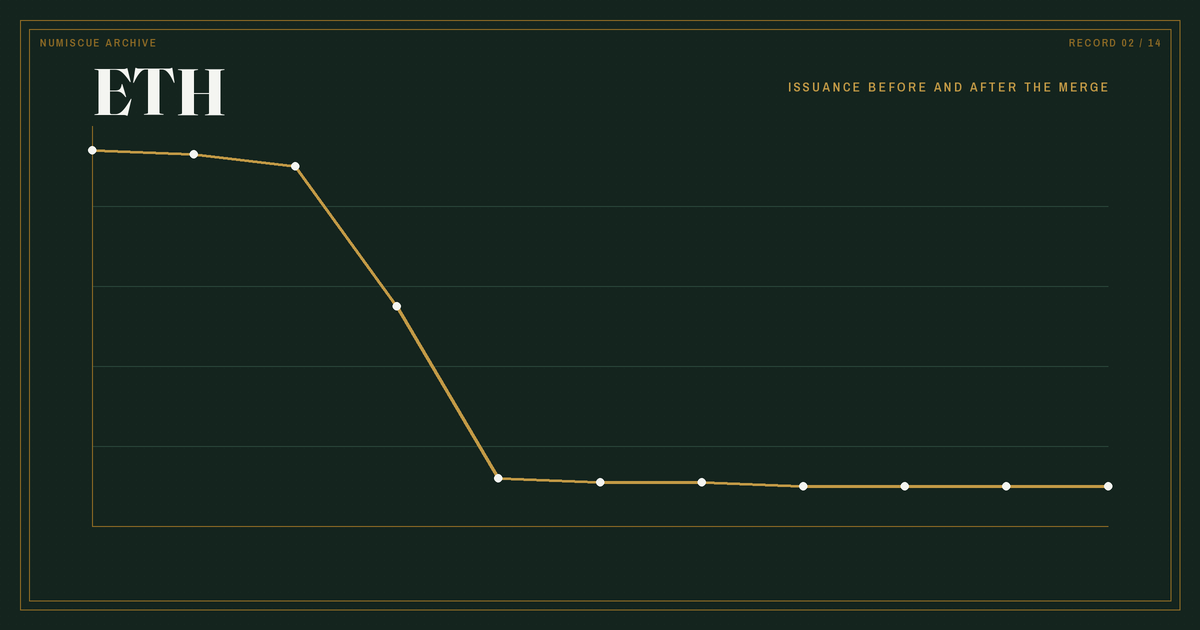
Ethereum is a programmable settlement network whose native unit, ether, is created to pay validators and destroyed by a fee that every transaction burns, so its total supply can grow or shrink depending on how busy the network is.
The short version
- Two supply flows run at once: issuance to validators, and a burn of the base fee.
- Issuance varies with active stake and validator participation; the burn tracks demand for block space.
- When the burn is larger, supply shrinks. When it is smaller, supply grows. Both happen.
- “Deflationary” describes one of those states, not the design.
- There is no maximum supply and no plan to introduce one.
What it is
Ethereum runs programs. That is the difference between it and Bitcoin in one sentence. Bitcoin's ledger records who has what; Ethereum's records who has what and the state of every piece of code deployed on it. Those programs — contracts, in the usual terminology — hold balances, enforce conditions and call each other, and they keep running as long as the network does.
Ether is the unit that pays for that computation. Every operation a program performs has a cost denominated in gas, gas is priced in ether, and you cannot get a transaction included without paying. That is the source of ether's demand as a working asset: it is the only thing the network accepts as payment for its own use.
Ethereum ran on proof of work until September 2022, when it switched to proof of stake in an upgrade known as the Merge. That event is the hinge of this record, because it is what turned a one-way supply schedule into a two-way one.
Who builds it
Ethereum has no single operator, but it has a denser institutional layer than Bitcoin does.
The Ethereum Foundation is a Swiss non-profit that funds research, coordinates protocol work and runs the core developer process. It does not control the protocol — it cannot force anyone to run software — but its convening role is real and it employs or funds a large share of the people who write specifications.
Protocol changes move through a public proposal process. An EIP is drafted, argued over, and if it gains consensus among client teams it goes into an upgrade. Multiple independent client teams implement each upgrade, deliberately, so that a bug in one implementation does not stop the chain. That client diversity is a design goal that is only partly achieved: some clients have much larger shares than others, which is a known concentration point.
Validators are the operational layer. Anyone with 32 ETH can run one; below that, staking pools and liquid staking protocols aggregate smaller deposits. Those pools are where a meaningful share of validation now sits, which is discussed under risk.
How the token works
There is no maximum supply of ether. There never has been, and unlike Bitcoin's cap this is not a number that was chosen and fixed — it is an absence. Ethereum's supply is governed by two ongoing flows, and the interesting part is that they point in opposite directions.
Flow one: issuance
Validators are paid newly created ether for proposing and attesting to blocks. The amount issued depends on total active stake and validator participation. It is not a fixed annual allocation; the relationship between total stake and rewards is explained below.
Ethereum's own documentation puts the numbers plainly. Before the Merge the total annualised issuance rate was around 4.61%, split between miners at roughly 4.09% and stakers at roughly 0.52%. After the Merge, execution-layer issuance went to zero and the total dropped to around 0.52% — a reduction of about 88.7%. That single change is the largest supply-side event in Ethereum's history.
Flow two: the burn
Since the London upgrade in 2021, every transaction pays a base fee that is calculated by the protocol and then destroyed. Not paid to a validator. Not sent to a treasury. Removed from existence. Separately, users can add a priority fee — a tip — and that part does go to the block proposer.
The base fee floats with congestion: it rises when blocks are full and falls when they are not. So the burn rate is a direct function of how much people want to use the network at any given moment.
Where the two meet
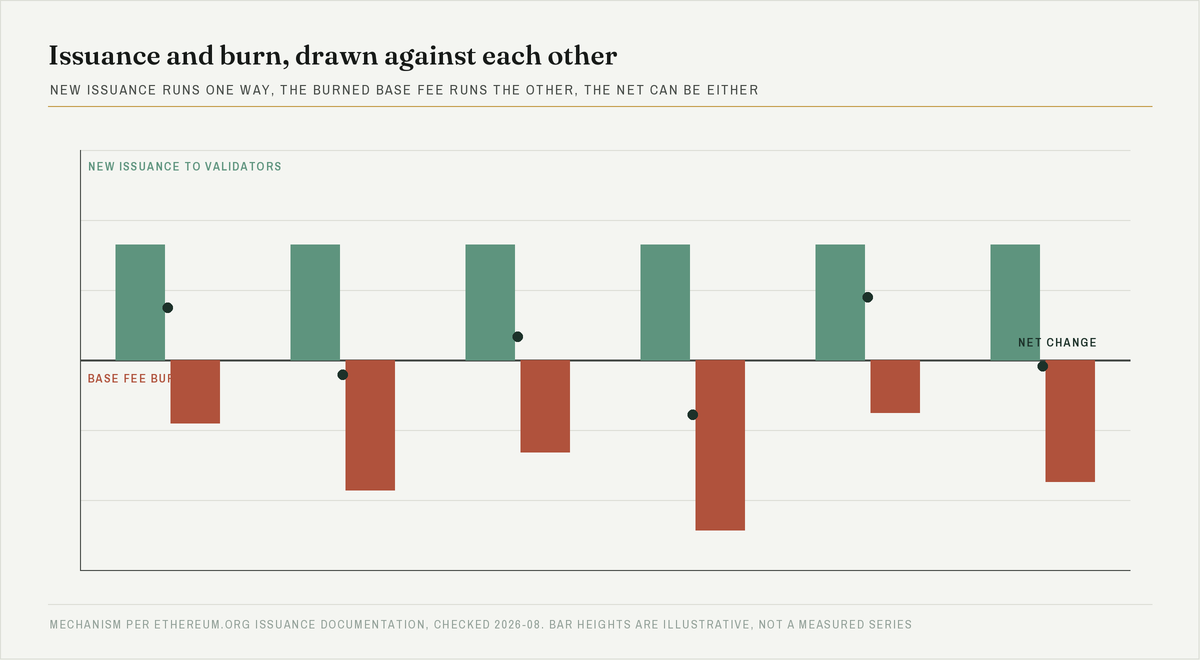
Ethereum's documentation gives a useful reference point: if the average gas price for a day is at least about 16 gwei, the burn offsets the roughly 1,700 ETH issued to validators that day, bringing net inflation to zero or below.
Above that level of activity, supply shrinks. Below it, supply grows. Both have happened repeatedly since the burn was introduced, sometimes within the same week.
This is where a lot of writing about ether goes wrong. “ETH is deflationary” is a claim about one possible state of a two-way mechanism, presented as if it were a property of the design. The accurate statement is duller and more useful: ether's net supply change is a function of network demand, and it can be either sign. If you are trying to reason about supply, the question to ask is not “is it deflationary” but “what does sustained activity look like, and does the burn clear issuance at that level?”
One more consequence worth naming: a large share of ether is staked and therefore not readily available to sell, and a further share sits in contracts. Neither is a supply cap, but both affect how much is actually loose at any moment. If that distinction is unfamiliar, the guide on reading supply schedules works through it properly.
The other lever: how much is staked
Issuance is not a single fixed number, and the thing that moves it is the total amount of ether staked across the network.
For a validator whose effective balance stays the same, the base reward is inversely proportional to the square root of total active stake. With comparable validator participation, total issuance across the network therefore grows with the square root of total stake. That is a deliberate design choice with a counter-intuitive consequence: as more ether is staked, the total issued rises, but the yield each individual validator earns falls. The network is buying security, and it pays progressively less per unit as it gets more.
So a rise in staking participation means more ether created in absolute terms and a worse return for everyone already staking. That self-limiting property is intentional; it is what stops the entire supply being staked. When you see a projection of Ethereum's future issuance, the assumption it rests on is a staking ratio, and that assumption is doing more work than anything else in the model.
Reading the supply numbers yourself
Three habits make Ethereum's supply data legible, and they are worth more than any article's summary.
Look at a window, not a moment. Net supply change over a day is noise; over a quarter it tells you something about the regime the network has been in. Anyone quoting a burn rate without a period is quoting nothing.
Separate the burn from the tip. Only the base fee is destroyed. Total fees paid and total ether burned are different numbers and are frequently conflated in coverage.
Check the staking ratio alongside issuance. Issuance without the ratio behind it cannot be projected forward, because the ratio is what determines it.
What it is actually used for
Ether has an unusually clear working use, which is rare among the assets in this archive: you need it to do anything on Ethereum. That is not a story about future adoption, it is a mechanical requirement today.
Beyond paying for gas, the main things actually happening on the network are stablecoin transfers — by volume, one of the largest categories of activity — trading and lending through automated contracts, collateral management, and issuance of tokens including a growing amount of tokenised traditional assets. Non-fungible tokens are still present but are a much smaller share of activity than the 2021–22 coverage would suggest.
A large and growing share of transactions no longer settles directly on Ethereum at all. They happen on layer 2 networks that batch activity and post it back to Ethereum periodically. Those networks pay Ethereum for data availability, which means the base chain increasingly earns from being settled to rather than transacted on. If you want to understand what that means for costs and for where your assets actually live, the layer 1 and layer 2 guide starts from exactly that question.
Staking is the other significant use: ether locked to secure the network, either directly or through a pool, earning a share of issuance and fees.
Risk checklist
- No supply ceiling exists. Whether supply grows or shrinks depends on demand for block space, which is not something anyone controls or guarantees.
- Staking is concentrated. A significant share of validation runs through a small number of large staking providers and liquid staking protocols. Those are coordination points that plain proof of stake does not require but practice has produced.
- Client diversity is uneven. The multi-client design exists to contain implementation bugs, but usage is not evenly spread across clients, which narrows the protection.
- Contract risk is not protocol risk. Most losses on Ethereum come from bugs or exploits in deployed contracts, not from the chain failing. Holding ether does not expose you to that; using an application does.
- Layer 2 assets carry bridge assumptions. Value held on a layer 2 depends on that network's own security model and its bridge back to Ethereum. This is a different risk surface.
- Fees are demand-driven and can spike. The base fee mechanism smooths the rate of change but does not put a ceiling on it.
- The roadmap is long and unfinished. Several planned upgrades are still ahead. Delivery has historically been slower than announced timelines.
Where to buy
Ether is listed on every significant centralised exchange and across decentralised venues, in a wide range of quote currencies. As with bitcoin, liquidity is rarely the constraint.
Before you buy, check which network you intend to hold ether on. Ethereum mainnet and a layer 2 keep separate balances even when a self-custody wallet uses the same address on both. Matching address formats do not show that a receiving exchange supports the selected network. Check the asset and network on its deposit page before withdrawing; an unsupported route can leave funds inaccessible.
What the upgrades ahead change about this picture
Ethereum ships changes through scheduled upgrades, and the ones on the roadmap touch the supply picture indirectly rather than directly. Worth knowing which is which.
Nothing planned introduces a supply cap. That has never been on the roadmap and is not a live proposal. Anyone describing a future cap is describing something that does not exist.
Changes to validator economics move issuance. Proposals around how many validators the network needs and how they are rewarded feed directly into how much ether is created, because issuance is a function of the staking set. These are the changes to watch if supply is what you care about.
Capacity work moves the burn. Anything that makes block space cheaper reduces the base fee and therefore the burn. That is the reverse of what people often assume: the more successfully Ethereum scales its data capacity, the less it burns per transaction, and the more transaction volume it needs to reach the same net effect on supply.
That second point is the one worth sitting with. Cheaper is good for users and less deflationary for the token, and both of those are consequences of the same success. Any argument that treats scaling and supply reduction as pointing the same way has skipped a step.
Questions people actually ask
Is ether deflationary?
Supply shrinks while fee burns exceed issuance and grows when issuance is higher. Issuance depends on total active stake and validator participation, while burning depends on demand for block space. Calling ETH deflationary treats one possible state as permanent.
Where does the burned ETH go?
Nowhere. The base fee portion of each transaction is destroyed by the protocol rather than paid to anyone. The separate priority fee, the tip, does go to the block proposer.
How much did issuance actually fall at the Merge?
Ethereum's own documentation puts the annualised issuance rate at roughly 4.61% before the Merge and roughly 0.52% after, a reduction of about 88.7%. The drop came from execution-layer issuance to miners going to zero.
Issuance rates, the 88.7% reduction and the 16 gwei break-even reference all come from ethereum.org's page on issuance before and after the Merge, read in August 2026. Slot timing is a protocol constant. Nothing on this page is a live figure; for current supply and burn rates use a chain explorer.
The reward relationship and address distinction were rechecked on 16 October 2026 against ethereum.org’s proof-of-stake rewards documentation and its wallet guide. A shared address does not merge balances across networks.
Related: the record for a fixed-cap coin · how Ethereum's fee model compares to others · supply structure table