Tether is a dollar-referenced token issued by a private company against a pool of reserves whose composition is reported quarterly in an assurance opinion prepared by an accounting firm — a document that is not, and does not claim to be, a financial statement audit.
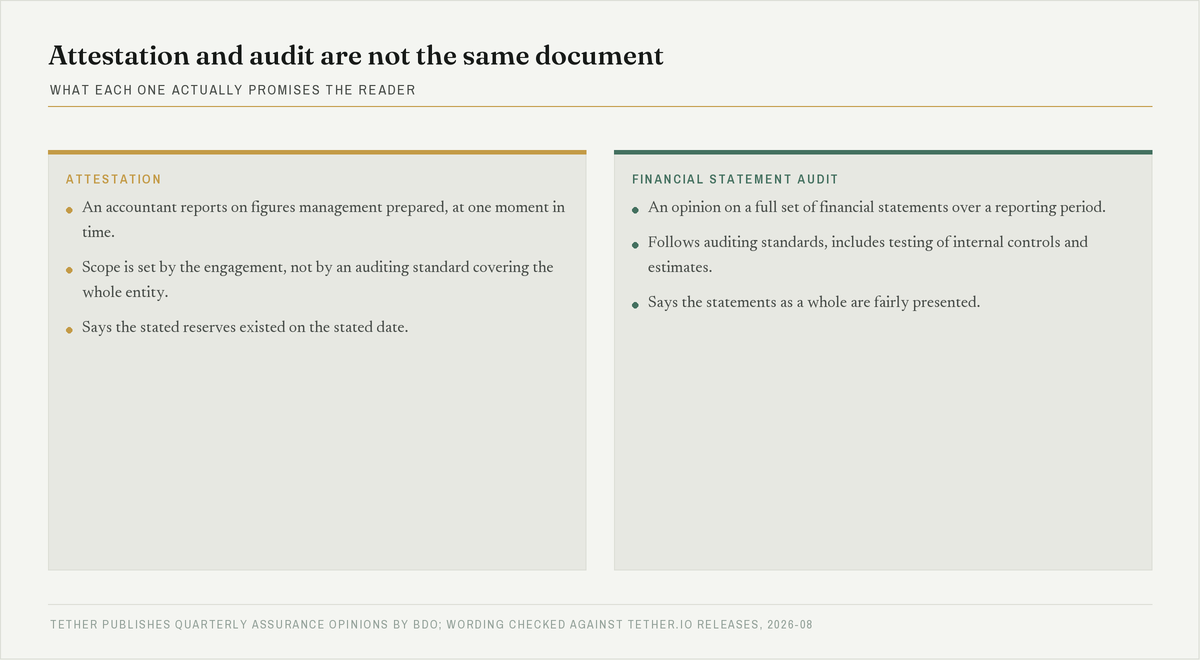
| Attestation / assurance opinion | Financial statement audit | |
|---|---|---|
| What is examined | Figures management prepared, usually as at one date | A complete set of financial statements covering a period |
| Who sets the scope | The engagement letter | Auditing standards, applied to the whole entity |
| What it concludes | The stated figures agree with underlying records at that moment | The statements as a whole are fairly presented |
| Covers internal controls | Not necessarily | Yes, as part of the audit approach |
| Says anything about tomorrow | No | No |
What it is
A Tether token, USDT, is a claim recorded on a blockchain that its issuer says is backed by reserves worth at least as much as the tokens outstanding. It is not a dollar. It is not a deposit at a bank. It is a liability of a private company that references a dollar.
That distinction sounds pedantic until something goes wrong, at which point it is the only thing that matters. A dollar in an insured bank account and a dollar-referenced token issued by a company are two different instruments with two different failure modes.
USDT exists on many chains simultaneously — Ethereum, Tron, Solana and others — as separate token contracts that all reference the same reserve pool. The version you hold on one chain is not automatically usable on another, which is one of the most common practical mistakes with this asset.
Who builds it
Tether is issued by Tether Holdings and related entities, private companies that have historically been associated with the exchange Bitfinex through shared ownership and management. That association has been the subject of regulatory attention and is a matter of public record.
There is no protocol here in the sense that Bitcoin or Ethereum have one. Issuance and redemption are company operations. The token contracts on each chain include functions the issuer controls, including the ability to freeze balances at specific addresses, which has been used in response to law enforcement requests. That capability is documented and is a design choice, not a flaw, but it means holding USDT is not equivalent to holding a bearer asset.
How the token works
Tokens are created when someone deposits with the issuer and requests them, and destroyed when tokens are returned for redemption. There is no schedule, no cap and no emission curve. Supply is whatever demand for issuance minus redemption has produced.
Because of that, the usual supply questions in this archive do not apply. The question that replaces them is: what is behind the tokens, and how would you know?
The reporting
Tether publishes quarterly assurance opinions prepared by BDO, a large international accounting firm. These have appeared under a few names over the years, most recently as a consolidated financial figures and reserves report. The company also publishes circulation figures on a much more frequent basis.
What that gives you is a professional accountant's opinion that the reserves report agrees with underlying records as at a stated date. What it does not give you is an audit opinion on Tether's financial statements as a whole, and Tether does not describe it as one.
Why this record does not list reserve percentages
You will find plenty of articles quoting a breakdown of Tether's reserves — so much in Treasury bills, so much in secured loans, so much in other assets. Those numbers are real when published and stale within a quarter, and repeating them here would make this page wrong on a predictable schedule.
The composition is published by Tether each quarter. If you want it, read the current report. What belongs in a record like this is the structure: a private issuer, a reserve pool the issuer manages, a quarterly opinion from an accounting firm on a report the issuer prepares, and no audit of the entity as a whole.
What to look at instead of the headline
If reserve percentages go stale and the report type is fixed, what is actually worth checking each quarter? Four things, none of which is the number most coverage leads with.
- The date the position was taken. An attestation reports a moment. How far in the past that moment is tells you how much can have changed since.
- What is in the reserve besides cash and government paper. The categories have varied over the years and have included assets that are neither. Those carry price and liquidity risk that Treasury bills do not.
- The buffer. Reserves above the amount of tokens outstanding is the cushion between a fall in asset value and a shortfall. Whether it is thick or thin is a more useful question than the composition split.
- Whether the reporting entity or the report's name has changed. Both have, more than once. A change in what is being reported on is worth noticing, in either direction.
None of those is a judgement about whether the reserves are adequate. They are the questions that let you form one, which is a different service from being told an answer.
What it is actually used for
USDT is, by transfer volume, one of the most heavily used assets in the entire market, and its main uses are unglamorous.
It is the default quote currency on centralised exchanges: most trading pairs are priced against it rather than against actual dollars, because moving USDT between venues is faster and simpler than moving bank money. It is used to sit out of the market without leaving the crypto system. And in a number of countries with capital controls or unstable local currencies, it functions as a practical way to hold and move dollar-referenced value outside the domestic banking system — a use that is large, real, and mostly invisible from the trading data.
Tron and other low-fee chains carry a large share of that transfer activity, because sending a dollar-referenced token is only useful if it does not cost several dollars to send.
Risk checklist
- Issuer credit risk. USDT is an obligation of a private company. If the reserves are insufficient or inaccessible, the token's reference to a dollar is a statement of intent, not a guarantee.
- Reserve composition is not all cash. Reported reserves have included assets other than cash and short-term government paper. Those carry price and liquidity risk that a pure cash reserve would not.
- No financial statement audit. Quarterly assurance opinions cover a reserves report; they are not an audit of the issuer. This is Tether's own description, not an accusation.
- Direct redemption is not universal. Redemption is governed by the issuer's terms, including eligibility and minimum sizes. Most holders exit through an exchange rather than by redeeming, which means they are relying on market liquidity rather than on the reserve.
- Balances can be frozen. The issuer can and does freeze specific addresses.
- Regulatory history. Tether and associated entities have been subject to settlements and enforcement actions, including a 2021 settlement with the New York Attorney General. Public record.
- Chain confusion. USDT on different chains is not interchangeable. Sending to an address on the wrong network is a common and often unrecoverable error.
Where to buy
USDT is available on effectively every centralised exchange and on decentralised venues across multiple chains. Because it is usually the quote asset rather than the traded one, acquiring it is normally a matter of depositing local currency and buying it directly.
The thing to get right is the network. Choose the chain you actually intend to use before you withdraw, and confirm the receiving address type matches it.
The chain problem, in more detail
USDT exists as separate token contracts on many networks that all reference the same reserve. That sounds like an implementation detail and is the source of most practical losses involving this asset, so it earns its own section.
They are not one balance. USDT on Ethereum and USDT on Tron are different tokens, on different networks, with different contract addresses. Holding one does not give you the other. There is no automatic conversion.
The address formats differ, and sometimes they do not. An Ethereum address and a Tron address look nothing alike, so a mismatch is at least visible. An Ethereum address and an address on any EVM-compatible chain are indistinguishable, so a mismatch there is invisible until the funds are gone. The address identifier will tell you which family you are looking at and why.
Fees differ by orders of magnitude. The same transfer can cost a few dollars on one network and a fraction of a cent on another, which is exactly why so much USDT volume ended up on Tron rather than on Ethereum.
Support differs by venue. Not every exchange accepts deposits on every network, and the list it accepts for deposits is not always the list it offers for withdrawals. Check both sides before you move anything.
The habit that avoids all of it: pick the network at the start, confirm the receiving side expects that network, and send a small test amount first when the route is new.
Questions people actually ask
Is an attestation the same as an audit?
No. An attestation is an accountant reporting on figures management prepared, usually as at a single date, within a scope set by the engagement. A financial statement audit is an opinion on a complete set of statements covering a period, prepared under auditing standards. Both are real professional work; they answer different questions.
Who prepares Tether's reserve reports?
BDO, a large international accounting firm, produces quarterly assurance opinions on Tether's reserves report. The reports have been published under different names over time, most recently as a consolidated financial figures and reserves report.
Does an attestation mean I can redeem my USDT for a dollar?
It does not speak to that. Redemption is governed by Tether's own terms, which set out who may redeem, in what size, and with what verification. Whether a report says the reserves existed is a separate question from whether you personally have a redemption route.
The quarterly cadence, BDO's role and the wording of the reports were checked against Tether's own attestation announcements and its transparency page in August 2026. Reserve composition changes every quarter and is deliberately not reproduced here; read the current report instead.
Related: the record for USDC, and how its structure differs · what actually backs the big stablecoins · the chain that carries much of the transfer volume