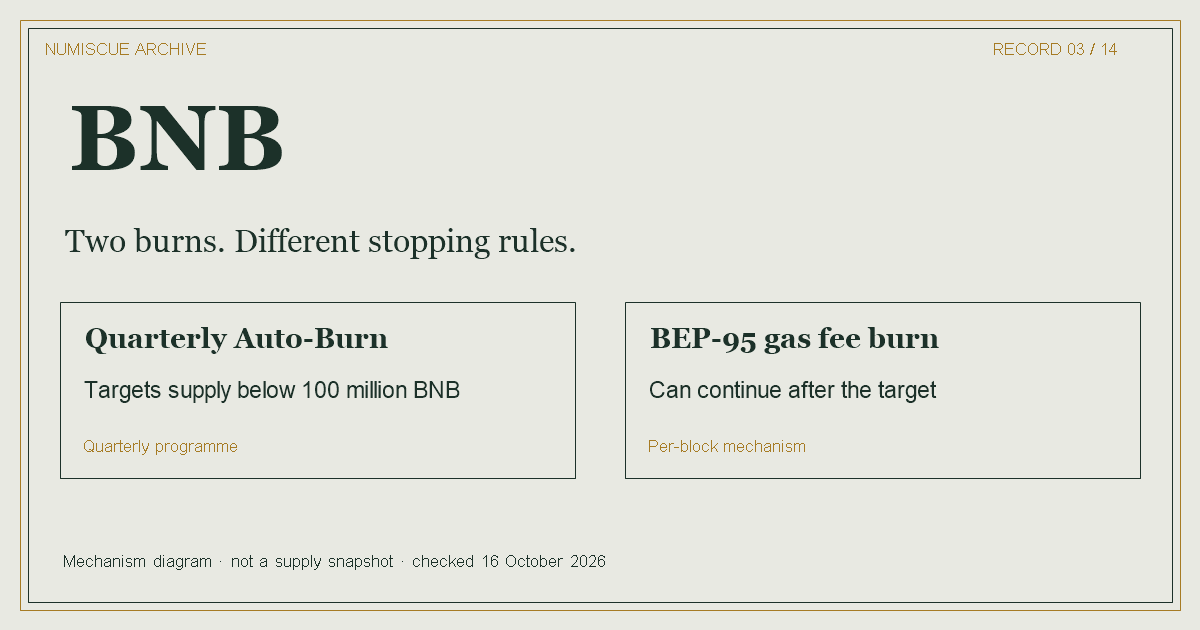
BNB is the native token of BNB Chain and of Binance's exchange ecosystem, whose supply is reduced by two separate burn mechanisms. The quarterly one is described as stopping once supply falls below 100 million tokens; the per-block one is not.
Stated parameters
- Initial total supply
- 200,000,000 BNB at launch in 2017.
- Stated destination
- Under 100,000,000 BNB, at which point the quarterly auto-burn is described as stopping.
- Quarterly mechanism
- Auto-Burn, calculated as B = N ÷ (100 × P) × K, where N is blocks produced that quarter, P is the average BNB price over the quarter, and K is a constant anchor initially set at 1,000.
- Continuous mechanism
- BEP-95, live since November 2021, burning a share of gas fees in every block. Initial ratio 10%.
A conflict of interest, before you read further. BNB is issued by Binance, and Numiscue holds a registered referral arrangement with that exchange. This is the one record on the site where that matters, so it is stated here rather than left to the footer. The record uses the same source and risk standard as the other thirteen, keeps its enforcement and concentration risks intact, and was not softened for the arrangement; the terms are on the funding disclosure page.
What it is
BNB started in 2017 as a token issued on Ethereum by the exchange Binance, giving holders a discount on trading fees. It has since become the gas token of BNB Chain, a separate network that Binance initiated, and the two roles now sit on top of each other.
That dual identity is the thing that makes this record different from the others. Most tokens in this archive are tied to a protocol. This one is tied to a protocol and to a company's commercial business, and its supply mechanism references the token's own market price. Whether you consider that a feature or a problem, it is unusual and it needs stating clearly.
Who builds it
Two entities, with an intentionally blurred boundary.
Binance is a cryptocurrency exchange group, one of the largest by volume, which issued BNB and operates the fee-discount programme, the launch platform and the various products that consume the token. It is a commercial company.
BNB Chain is the network. It is presented as a community-driven open-source project with its own governance, contributor base and validator set, distinct from the exchange. Validators are elected by staked BNB, and the validator count is capped at a number far smaller than networks like Ethereum use — a deliberate trade for throughput, discussed under risk.
The separation between the two is real at the level of code and organisation, and thinner at the level of origin, branding and economic interest. This record does not attempt to score how separate they are. It notes that the question exists, because it does not exist for most of the other records here.
How the token works
BNB launched with 200 million tokens and no ongoing issuance. There is no block subsidy creating new BNB. The entire supply story is subtraction.
Auto-Burn, quarterly
Every quarter, an amount of BNB is destroyed according to a published formula. The inputs are the number of blocks BNB Chain produced during the quarter and the average BNB price over that quarter, combined with a fixed constant.
Price sits in the denominator, so the formula burns more tokens when the price is lower and fewer when it is higher. The stated intent is to keep the value destroyed roughly steady rather than the count. Auto-Burn replaced an earlier process in which Binance decided each quarter's burn size directly; the formula's purpose is to make the amount predictable from public data rather than discretionary.
Binance Academy's documentation states that 35 quarterly burn events had been completed as of April 2026.
BEP-95, continuously
Separately, since November 2021, a portion of the gas fees collected in each block on BNB Chain is sent to a burn address rather than to the validator. The initial ratio was 10% of gas fees. This runs every block, independent of the quarterly process, and is described as continuing even after the quarterly burn stops.
What the 100 million target does and does not mean
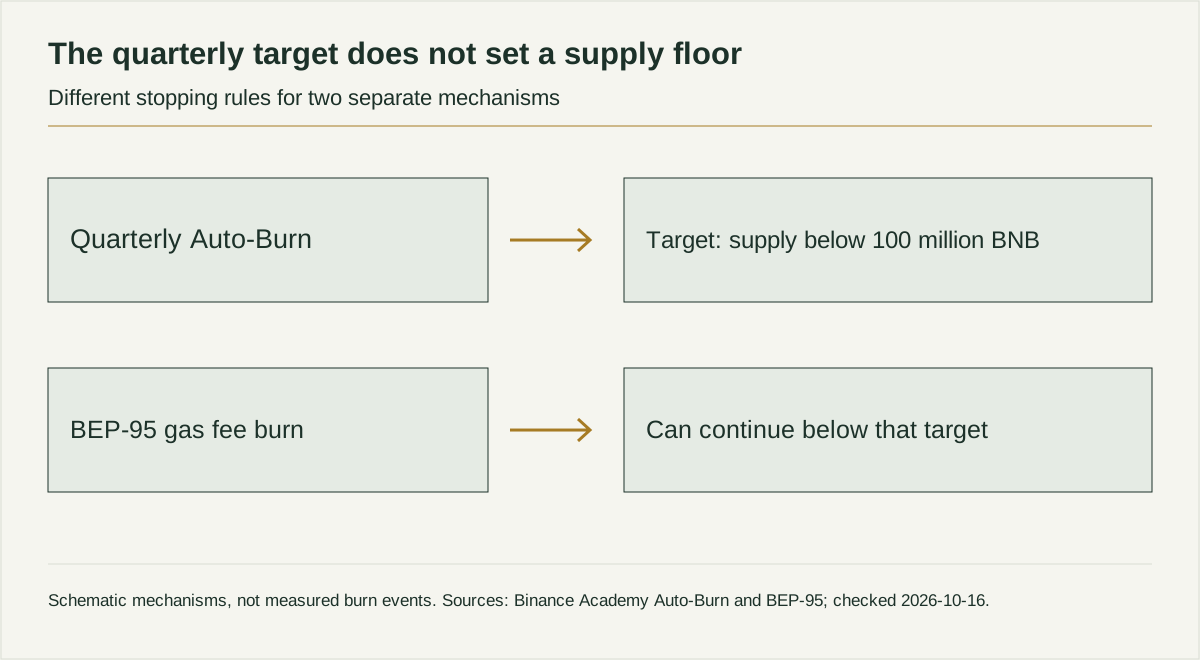
The quarterly Auto-Burn programme targets supply below 100 million BNB. That is not a protocol minimum: the BEP-95 gas burn can continue after the target is reached, reducing supply further. The quarterly target depends on the executing party following the announced programme; it should be distinguished from the gas-burn rules implemented in chain contracts. Compare Bitcoin's 21 million, which no single party can alter, or Avalanche's 720 million, which is a cap in the protocol.
Whether the distinction matters to you is a judgement. That there is a distinction is a fact, and it is the sort of thing that gets lost when a token is described simply as “deflationary with a hard cap”.
What it is actually used for
BNB has more concrete uses than most tokens, and they cluster in two places.
On BNB Chain, it is the gas token. Every transaction and contract call is paid for in BNB, so anyone using the network needs some. It is also staked to elect validators and to participate in governance votes.
In the Binance ecosystem, it pays discounted trading fees, is used in the exchange's launch and subscription products, and functions as collateral in various exchange services. This is the demand that is tied to one company's product decisions rather than to a protocol.
The honest summary is that a large part of BNB's utility exists because a company chose to give it utility, and could choose differently. The chain usage is more durable in the sense that it does not depend on a commercial decision, but the chain's own activity is itself heavily shaped by its association with the exchange.
Risk checklist
Facts, stated without a score. This is the longest risk section in the archive, which reflects the number of distinct dependencies rather than a verdict about severity.
- The quarterly target is a programme commitment. The 100 million figure is where the quarterly burn is described as stopping, not a minimum supply; the BEP-95 gas burn is described as continuing past it. The quarterly target is not enforced by nodes rejecting blocks the way a protocol cap would be.
- The burn formula references the token's own price. That is unusual. It means the supply schedule depends on a market input rather than only on chain data, and on whatever price source is used to determine the quarterly average.
- Concentration between token and issuer. A substantial share of BNB's usefulness comes from one company's products. Commercial decisions, regulatory action against that company, or changes to its fee structure all feed back into the token in a way that does not apply to protocol tokens.
- Regulatory history. Binance has been the subject of enforcement action and settlements in multiple jurisdictions, including a US settlement in 2023 and restrictions on operating in various countries. This is public record and is a live consideration rather than a closed chapter.
- Small validator set. BNB Chain runs with far fewer active validators than networks like Ethereum. That buys throughput and costs decentralisation; it also means the set of parties who must cooperate to change or halt things is small.
- Chain incidents. BNB Chain has experienced significant security incidents, including a cross-chain bridge exploit in October 2022 during which the chain was halted by validator coordination. That the chain could be halted is itself a fact about its structure.
- Supply history is not fully on-chain. The token's early distribution and the transition from an Ethereum token to a native chain asset happened partly off-chain, so reconstructing the full history from public chain data alone is harder than for a coin mined from genesis.
Checking the burns yourself
Both burn mechanisms are observable on chain, which means none of this has to be taken on trust, and verifying it once is more useful than reading anyone's summary.
The quarterly burn. Each auto-burn event is a transaction to a burn address. Explorers show the amount and the timestamp. The publisher also puts out a report each quarter with the inputs used: the block count for the period and the average price. Whether the announced number matches the formula is arithmetic you can do yourself.
The per-block burn. BEP-95 destroys a share of gas fees continuously, so the burn address balance climbs steadily between quarterly events rather than in steps. Watching that address over a few days tells you the real rate rather than the announced one.
The total. Circulating supply figures are published by the usual data providers, and they are derived rather than authoritative. The burn address balance is the primary number: it is what has actually been removed, and nobody has to agree with anyone about it.
One thing verification does not settle: whether the programme continues. On-chain data tells you what has happened. It does not tell you what the entity running the burns will do next quarter, and that is the distinction between a programme target and a consensus rule that this record keeps returning to.
Where to buy
BNB is listed on Binance, where it has the deepest liquidity, and on a range of other centralised and decentralised venues, though availability varies by jurisdiction. It also trades on BNB Chain itself against the chain's own stablecoin and wrapped-asset pairs.
If you are holding BNB to pay gas on BNB Chain, note that you need the native asset on that chain specifically — a wrapped or bridged representation on another network will not pay for transactions there.
Supply figures, the burn formula and its variables, the quarterly cadence and the BEP-95 burn ratio are taken from Binance Academy's documentation of BNB Auto-Burn, read in August 2026. The enforcement and incident items in the risk list are matters of public record; verify current status with primary sources rather than relying on this page. Numiscue has a commercial relationship with Binance.
The quarterly target and continued gas burn were rechecked on 16 October 2026 against the Auto-Burn documentation above and Binance Academy’s BEP-95 explanation. The 100 million figure is not a minimum supply.
Related: how to read a supply and emission schedule · how BNB's structure compares · another token with a fee-burn mechanism