
Solana is a high-throughput proof-of-stake network whose token supply grows on a published disinflationary schedule: a starting rate that falls by a fixed percentage each year until it reaches a long-term floor.
The schedule as documented
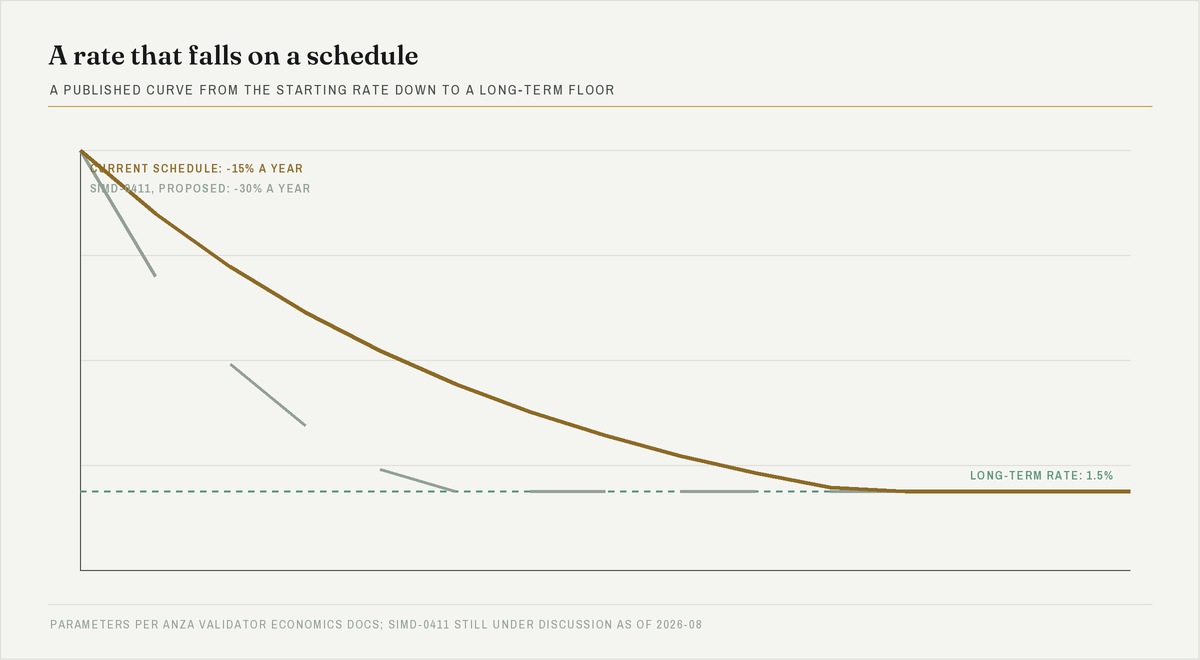
- Initial inflation rate
- Stated as a range of 7–9%, modelled at 8%.
- Disinflation rate
- Stated as −14 to −16% a year, modelled at −15%. Applied to the rate, not the supply.
- Long-term rate
- Stated as 1–2%, modelled at 1.5%. It does not fall below this.
- Status
- The documentation marks the schedule “subject to change” and the parameters “under study”. There is an open proposal to double the disinflation rate; see below.
What it is
Solana is a single-chain network built to process a large number of transactions per second without splitting into shards or pushing activity onto separate layers. Its distinguishing technical feature is a verifiable ordering of events that lets validators agree on sequence without as much back-and-forth messaging as other designs need.
SOL is the native token. It pays fees, it is staked to secure the network, and it is required as rent for accounts that store data on chain.
Who builds it
Solana Labs originated the network and the original validator client. The Solana Foundation, a Swiss non-profit, holds a coordinating role, funds development and runs grant programmes.
Client development has broadened over time. The original client is now maintained under the name Agave by a separate organisation, Anza, and independent client implementations have been developed to reduce the risk that one codebase's bug stops the network. Adding a second widely used client has been one of the network's larger engineering efforts, for reasons that appear in the risk section.
Protocol changes move through SIMDs — Solana Improvement Documents — which are proposed publicly and, for economically significant ones, put to a stake-weighted vote.
How the token works
New SOL is created as staking rewards. Validators and the accounts that delegate to them receive newly issued tokens in proportion to stake, and the total amount issued follows the published schedule.
The mechanics of that schedule are worth being precise about, because the word “disinflation” gets used loosely. The disinflation rate applies to the inflation rate itself, not to the supply. Starting at 8% and applying −15% a year gives roughly 6.8%, then 5.8%, then 4.9%, and so on, converging toward the 1.5% floor rather than toward zero. Supply keeps growing; it just grows more slowly each year and never stops.
The open proposal
SIMD-0411 proposes doubling the disinflation rate from −15% to −30% a year. It does not change the starting rate or the floor; it changes how fast the curve gets there — by the proposal's own estimate, from about 6.2 years down to about 3.1 years.
As of the August 2026 check, the proposal was marked as under discussion with the voting timeline to be determined. That is the honest status. If you are reading this later, the thing to do is check whether it has been voted on rather than assume either way, because a change to the disinflation rate changes every forward projection of SOL supply.
Fees, and why they are not the whole picture
Base transaction fees on Solana are small and half of each is burned. Priority fees, paid to get ahead in the queue during congestion, have become a meaningful part of validator income and are not burned in the same way. Anyone modelling validator economics from the base fee alone will get the wrong answer.
Reading the throughput numbers
Solana is usually introduced with a transactions-per-second figure, and those figures need qualification. Theoretical maximums, measured peaks and sustained real-world throughput are three different numbers, and published totals often include validator vote transactions, which are internal network messages rather than user activity. A throughput claim that does not say whether votes are included is not a claim you can compare with anything.
Why the headline yield is not what you earn
Staking yield on Solana is quoted a lot and misunderstood in a specific way that follows directly from the schedule above.
Issuance is distributed across everything staked. So the rate an individual staker earns is roughly the network inflation rate divided by the proportion of supply that is staked. With a high staking participation rate, the individual yield sits close to the inflation rate; with a low one, it sits well above it.
Two consequences follow that are worth holding onto.
First, a headline staking yield is not a return in the way a deposit rate is. Much of it is dilution you are receiving back rather than being diluted by. If everyone stakes and the rate is the inflation rate, nobody's share of the total supply changes at all — the yield is entirely nominal.
Second, and this is where the schedule bites, the yield falls as the disinflation curve descends, regardless of what anyone does. That is not a sign of anything going wrong. It is the schedule working, and it means fees have to grow into the gap over time, exactly as they must on Bitcoin and Cardano. Every network with declining issuance faces the same question eventually; they just arrive at it by different routes.
What it is actually used for
The activity that low fees and fast confirmation actually attract, in order of visible volume: high-frequency trading through on-chain markets, token issuance and speculation including a very large share of small-cap token launches, payments and stablecoin transfers, consumer-facing applications that would be uneconomic at higher fees, and NFT activity.
SOL itself is used for fees, staking, and account rent. Staking participation is high relative to many networks, which means a large fraction of supply is committed and earning issuance rather than sitting loose.
Risk checklist
- The schedule is not fixed. Its own documentation says subject to change, and a proposal to alter it is live. Forward supply projections depend on a parameter that governance can move.
- Outage history. Solana has experienced full network halts and periods of severe degradation, several requiring coordinated validator restarts. Uptime has improved substantially, but the history is part of the record.
- Client concentration. For most of its life the network ran predominantly on one client implementation. Diversifying that has been a multi-year effort and the distribution is still uneven.
- Hardware requirements are high. Running a validator demands substantially more hardware and bandwidth than lighter networks, which limits who can participate independently.
- Stake concentration. A meaningful share of stake sits with large operators and staking services.
- Early allocation. A significant portion of initial supply went to insiders and early investors under vesting arrangements. Those schedules are largely historical now but shaped the distribution.
- Fee dynamics under congestion. When demand spikes, priority fees rise sharply and transactions can fail to land. Low average fees do not mean low fees at the moment you need them.
Where to buy
SOL is listed on all major centralised exchanges and trades widely on Solana's own on-chain markets. Liquidity is deep.
If you withdraw to a self-custodied wallet, remember that accounts on Solana require a small SOL balance to remain rent-exempt, so sending your entire balance away can leave an account in an awkward state. Keep a little back.
Inflation parameters, the stated ranges and the “subject to change” caveat come from Anza's validation client economics documentation. The status and effect of SIMD-0411 come from its thread on the Solana developer forum. Both read August 2026. Outage history is public record.
Related: how Solana's consensus compares · its fee model against other chains · another high-throughput network with a different structure