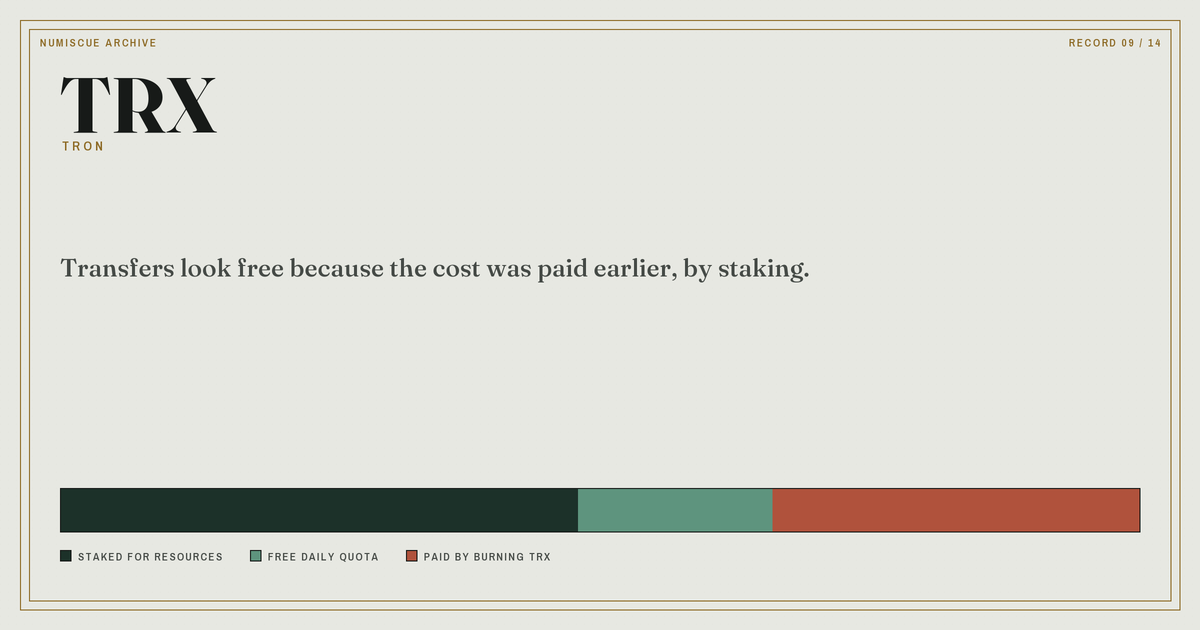
TRON is a delegated proof-of-stake network that charges for transactions in two rented resources, Bandwidth and Energy, which users obtain by staking TRX rather than by paying a fee at the moment of sending.
| Bandwidth | Energy | |
|---|---|---|
| Pays for | The size of the transaction on chain | Executing smart contract code |
| Cost basis | Equal to the transaction's byte count | A fixed cost per virtual machine instruction |
| Free daily allowance | 600 units | None at all |
| Daily network pool | 43.2 billion units | 180 billion units |
| If you have none | The network burns TRX at a fixed rate | The network burns TRX at a fixed rate |
What it is
TRON is a smart contract network with an EVM-compatible virtual machine, high throughput and a small elected validator set. Blocks come quickly and capacity is high.
The reason it earns a record here is not throughput. It is the fee model, which is different enough from the gas-auction approach used by Ethereum and most of its relatives that it produces a genuinely confusing user experience: transfers that appear to cost nothing.
Who builds it
TRON was founded by Justin Sun and launched its own mainnet in 2018 after starting as a token on Ethereum. The TRON DAO Reserve and associated entities hold a coordinating and treasury role.
Block production is handled by 27 Super Representatives, elected continuously by TRX holders who stake and vote. Candidates below that threshold act as partners and receive a share of rewards without producing blocks. Twenty-seven is a small number by design: it is what buys the throughput.
How the token works
TRX is created as block rewards paid to Super Representatives and their voters, and destroyed when transactions burn it. The interesting mechanism is not the issuance schedule — it is the resource system, because that is where most TRX actually goes.
Staking for resources, not for yield
Staking one TRX grants one unit of TRON Power. TRON Power gives you a proportional claim on the network's daily resource pools: 43.2 billion Bandwidth and 180 billion Energy. Stake more, and you get a larger share of those pools each day.
Crucially, using the resources you are entitled to costs you nothing. The staked TRX is not spent. It sits locked, generating a daily allocation, and you get it back when you unstake.
So the cost of transacting on TRON is not a fee — it is the opportunity cost of having TRX locked up. That is a completely different economic shape from paying gas, and it is why the network is described as having free transfers when it does not.
What happens when you have neither
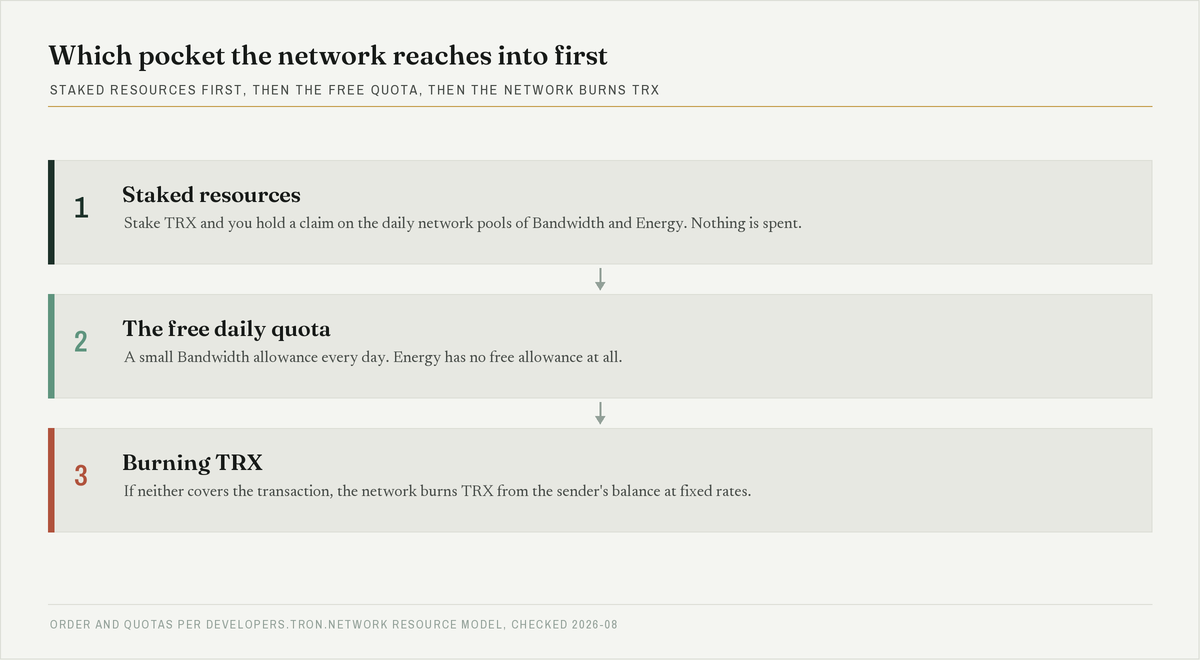
If a transaction needs more Bandwidth or Energy than you have available from staking and the free daily allowance, the network falls back to burning TRX from the sender's balance at fixed rates. The transaction still goes through, provided the balance covers the burn.
This is where the surprise lands. A new user with a fresh account sends a simple TRX transfer, uses part of their 600 free Bandwidth units, and pays nothing. Then they send a USDT transfer — which is a smart contract call and therefore needs Energy, of which they have no free allowance at all — and the network burns a noticeable amount of TRX. Nothing changed about the network. The second transaction simply used a resource the first one did not.
Why the burn matters for supply
Because failing to stake means burning, and because contract calls have no free allowance, TRON burns a meaningful quantity of TRX through ordinary use. Combined with block rewards being issued, net supply change depends on the balance between the two — the same two-way structure as Ethereum's, arrived at through a completely different mechanism.
What it is actually used for
Stablecoin transfers. That is the honest answer, and it dwarfs everything else on this chain.
TRON carries an enormous volume of USDT movement, particularly for remittances, over-the-counter settlement and transfers between exchanges. Cheap, fast, and well supported by exchanges as a withdrawal network, it became the default rail for moving dollar-referenced tokens in a lot of the world.
Beyond that there is a decentralised finance ecosystem, a gambling and gaming sector that has been prominent on the chain since early on, and general contract activity. But if you want to understand what TRON is for in practice, the answer is that it moves stablecoins, and the resource model is a large part of why.
That also explains the demand for TRX itself: businesses moving stablecoins at volume stake TRX to avoid burning it, which makes the token an operating input rather than only a speculative one.
What this means if you are actually going to use it
The resource model rewards preparation and punishes improvisation, so the practical advice is different from every other network in this archive.
Work out what you will be doing before you fund the account. Plain TRX transfers need Bandwidth, which has a free daily allowance. Anything touching a contract — and every stablecoin transfer is a contract call — needs Energy, which has none. Those are different resources with different economics, and the second is where the cost is.
If you will transact regularly, stake. Staked TRX is not spent; it generates a daily resource allocation and comes back when you unstake. If you will transact once, do not bother: paying the burn for a single transaction is cheaper than tying up capital.
Expect the first contract call to cost something. A new account with a small TRX balance can find its first stablecoin transfer consumes a noticeable amount of it. Nothing has gone wrong; the account simply had no Energy.
Leave a buffer. An account with exactly enough TRX for the amount you want to send and nothing spare cannot pay the burn, and the transaction fails.
Risk checklist
- Twenty-seven block producers. The elected validator set is small, which is a deliberate throughput trade and also a small number of parties whose cooperation determines the chain's behaviour.
- Voting is stake-weighted and participation is uneven. Large holders have correspondingly large influence over who produces blocks.
- Founder concentration. The project is closely associated with one individual, and associated entities hold significant positions. Concentration of both influence and holdings is a standing consideration.
- Regulatory attention. TRON's founder and associated entities have been the subject of regulatory proceedings in the United States. Public record; check current status with primary sources.
- The resource model is a usability trap. Users regularly find transactions burning TRX unexpectedly because contract calls need Energy and there is no free Energy allowance.
- Unstaking has a delay. Reclaiming staked TRX is not instant, so resources cannot be converted back to a liquid balance on demand.
- Concentration of use. The chain's activity is heavily weighted toward one use case. A shift in where stablecoin transfers happen would have an outsized effect here.
Where to buy
TRX is listed on most major centralised exchanges. If you intend to use the network rather than just hold the token, buy enough to stake for resources rather than the minimum, since an unstaked balance on TRON means paying by burn.
Addresses on TRON begin with T and are a distinct format from EVM addresses — if you are unsure what you are looking at, the address identifier will tell you and explain why the format looks the way it does.
The resource model, the 600-unit free Bandwidth allowance, the absence of a free Energy allowance, the daily pool figures and the staked-then-free-then-burn order all come from TRON's developer documentation on resources, read August 2026. Regulatory items are public record.
Related: how this compares with gas auctions and flat fees · the asset that dominates this chain's traffic · consensus mechanisms compared