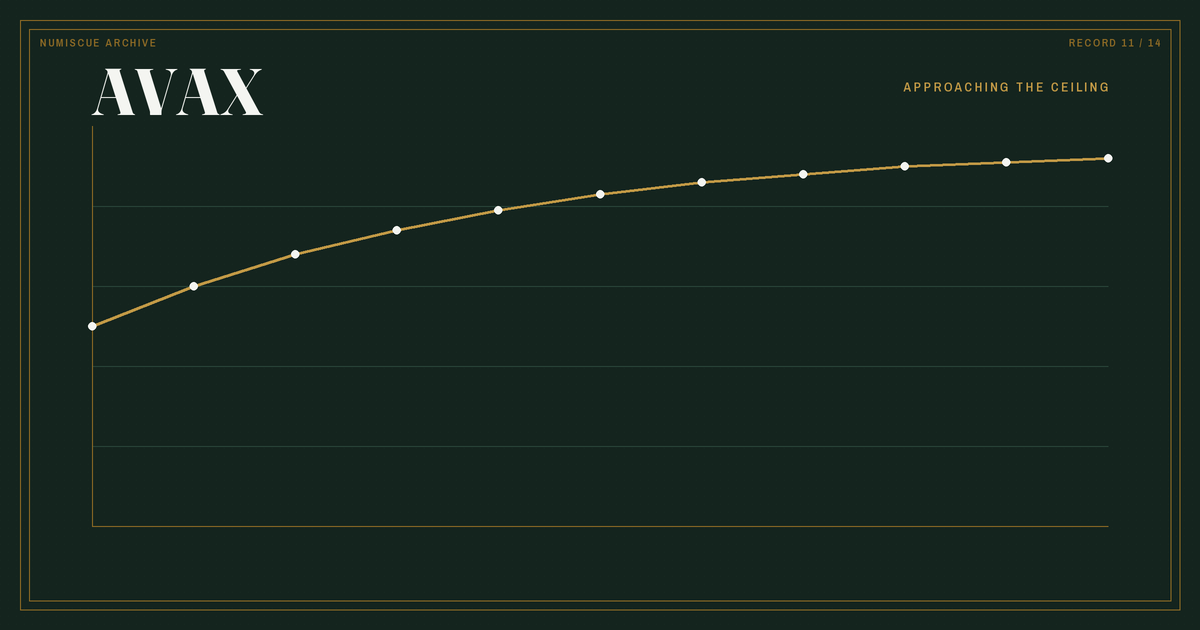
Avalanche is not one blockchain but a set of them: a three-chain Primary Network plus any number of independent networks launched on top of it, with AVAX as the asset that secures and pays for the base layer.
The structure in four lines
- P-Chain
- The platform chain. Tracks validators and coordinates the creation of new networks.
- X-Chain
- The exchange chain. Handles asset creation and transfer.
- C-Chain
- The contract chain. An EVM implementation, and where almost everything a normal user does happens.
- Avalanche L1s
- Independent networks with their own validators and rules. Avalanche Mainnet is the Primary Network plus all of these.
What it is
Most networks scale by making one chain faster or by pushing activity onto layers above it. Avalanche takes a third route: let people launch their own chains, each with its own validator set, rules and sometimes its own gas token, all using the same underlying consensus software.
Those networks were called subnets for years and were renamed Avalanche L1s in a 2024 upgrade that also changed how they relate to the Primary Network. You will still find the old term everywhere, and older documentation uses it. They refer to the same idea, and the change was substantive rather than cosmetic: L1s became more independent, with a lower cost to launch and no requirement for their validators to also validate the Primary Network.
AVAX is the native asset of the Primary Network. It secures it, pays its fees, and is what the supply cap applies to.
Who builds it
Ava Labs develops the core software and drives much of the ecosystem. The Avalanche Foundation supports the network with grants and incentive programmes.
The Primary Network is validated by anyone who stakes at least 2,000 AVAX and runs a node. There is no slashing for ordinary faults; validators that fail to meet an uptime requirement simply forgo their rewards. That is an unusual choice and worth knowing about — it lowers the risk of running a validator, and it means the punishment for poor performance is missing income rather than losing principal.
Individual L1s choose their own validators, which means their security is their own business and is not inherited from the Primary Network.
How the token works
AVAX has a hard cap: the supply will never exceed 720 million tokens. Unlike a burn programme aiming at a target, this is a protocol constraint.
360 million were minted at genesis. The rest enters circulation as staking rewards, and the reward rate falls as total supply approaches the ceiling — the closer it gets, the slower it mints.
The burn side
Every transaction fee on Avalanche is burned. Not the base portion with a tip going elsewhere: both the base fee and the priority fee are destroyed. That differs from Ethereum, where the priority fee goes to the block proposer.
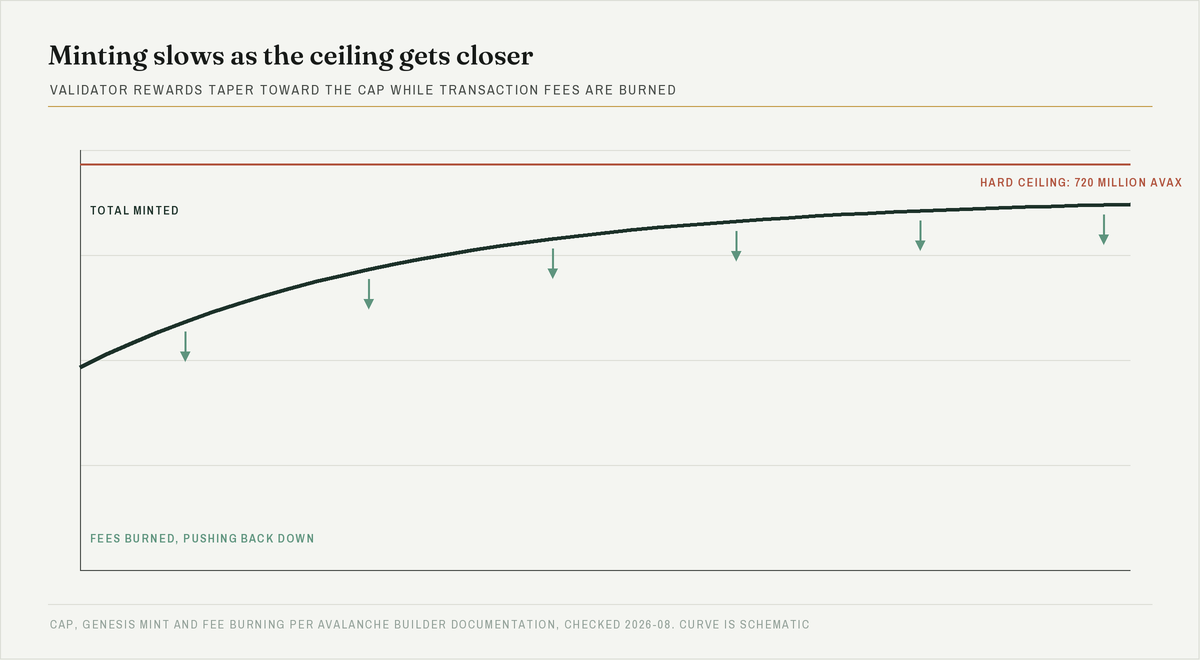
The two forces interact in a way worth stating plainly: minting slows as the cap approaches, and burning happens regardless of how close to the cap the supply is. In sustained high-usage conditions the burn can exceed new issuance, so the total does not simply climb to 720 million and stop — it can move in either direction beneath a ceiling it is not obliged to reach.
What the 2024 rename actually changed
Subnets became Avalanche L1s in an upgrade that was more than terminology, and the difference is worth setting out because a lot of material predates it.
Under the old model, anyone validating a subnet also had to validate the Primary Network. That meant staking 2,000 AVAX and running the full Primary Network workload before you could run anything of your own. For a small network, that was a substantial fixed cost imposed by a chain you did not care about.
The upgrade removed that requirement. An L1's validators can now validate only that L1, paying a smaller ongoing fee to the P-Chain for the right to exist rather than bonding into the Primary Network. Launching a network got cheaper and operationally lighter.
The trade is stated in the name. These are L1s now, not subnets, because they are genuinely independent chains rather than a segment of one network. An L1's security is its own validators' security, and if that set is small or permissioned, that is what your assets there are protected by. Sovereignty and inherited security are the two ends of the same dial.
Reward rates and the ceiling
One more mechanism, because it is where the cap actually bites.
Staking rewards on Avalanche depend on how much AVAX is staked, for how long, and how close total supply is to 720 million. Longer lock-ups earn more, which is unusual and is a deliberate incentive to commit. As total supply rises toward the cap, the rate paid falls.
Combine that with fees being burned entirely and the picture is a network that mints more slowly the closer it gets to its ceiling, while destroying supply at a rate set by usage. In heavy use the burn can exceed the mint. So the total does not simply climb to 720 million and stop — it can move in either direction under a ceiling it is not obliged to reach, which is a meaningfully different shape from Bitcoin's monotonic approach to its cap.
What it is actually used for
For an ordinary holder, essentially all activity happens on the C-Chain: EVM applications, lending, trading, stablecoins, NFTs. It behaves like any other EVM network and works with the same wallets and tools.
The L1 story is the differentiated one. Institutions and games have launched networks with their own rules — permissioned validator sets, custom gas tokens, compliance requirements built into the chain itself. That is a genuine use case for organisations that cannot run on a fully public chain, and it is where a meaningful part of Avalanche's business development has gone.
AVAX itself is used for staking, for Primary Network fees, and as the asset an L1 must interact with if it uses the Primary Network's services.
The practical bit: which chain is your balance on?
This is the thing that actually costs people money, and it is why this record leads with structure.
AVAX exists on the X-Chain, the P-Chain and the C-Chain, and the same wallet holds separate balances on each. Moving between them is a cross-chain transfer within Avalanche, not a normal send. Exchanges differ in which chain they withdraw to — most use the C-Chain, some use the X-Chain — and depositing to the wrong one causes a stuck transfer that support has to untangle.
Add L1s to that and the question multiplies. An asset on an Avalanche L1 is not automatically usable on the C-Chain; it needs a bridge, and bridges have their own risk. Before you withdraw anything, check which chain the receiving address expects. The address identifier can tell you what family an address belongs to, though within Avalanche the C-Chain uses the same address format as Ethereum, so the chain selection at withdrawal time is the thing to get right.
Risk checklist
- L1 security is not inherited. Each L1 is secured by its own validators. A small or permissioned set means the security of assets there is that set's security, not Avalanche's.
- Bridge exposure. Moving assets between L1s and the C-Chain means using a bridge. Bridges have historically been among the most exploited components in the industry.
- Cross-chain confusion within one network. Three Primary Network chains with separate balances is a real source of user error.
- No slashing for ordinary faults. Validators lose rewards rather than principal for downtime. That is a deliberate trade with a different incentive profile from slashing chains.
- Validator minimum is high. Two thousand AVAX to validate independently puts direct participation out of reach for most holders, pushing them toward delegation.
- Ecosystem incentive dependence. A portion of activity has historically followed funded incentive programmes, and activity that arrives with incentives can leave with them.
- Early allocation and unlocks. A significant share of genesis supply went to the team, foundation and early backers under multi-year schedules.
Where to buy
AVAX is listed on all major centralised exchanges. The one thing to get right is the withdrawal network — check whether the exchange sends to the C-Chain or the X-Chain and make sure your destination expects that chain.
The 720 million cap, the 360 million genesis mint and the burning of both base and priority fees come from Avalanche's own AVAX token documentation; the Primary Network structure and the 2,000 AVAX validator minimum from the Primary Network page; the relationship between Mainnet and L1s from the Avalanche L1s page. All read August 2026.
Related: why the same coin on two chains is not interchangeable · which chain is this address on · supply structure table