Toncoin is the native asset of The Open Network, a proof-of-stake blockchain whose defining characteristic is not its throughput or its supply schedule but its integration with Telegram's messaging platform.
The short version
- Initial supply five billion, originally distributed by mining, which ended in June 2023.
- Validators earn new coins; annual issuance is about 0.6% of supply.
- Since June 2023, half of every transaction and storage fee is burned.
- The burn touches fees only. New issuance is unaffected by it.
- Distribution runs through Telegram, and so does the concentration risk. Same fact, both ways.
What it is
The Open Network is a high-throughput blockchain using a sharded design, in which a masterchain coordinates a set of workchains that can themselves split as load requires. It was originally designed inside Telegram, abandoned by the company after regulatory action in the United States, and picked up by an independent community that continued the work.
The relationship with Telegram then re-formed at the product layer rather than the corporate one, and that is the arrangement in place today: an independent network, deeply integrated into an application with a very large user base.
Who builds it
Development is coordinated by the TON Foundation and a set of independent contributors, on open-source code. Telegram is not the operator of the network.
The connection is commercial and product-level. Telegram's wallet, Mini Apps, collectible usernames, its Stars currency and its advertising payouts all touch TON in various ways. Telegram's founder has been publicly associated with the network's promotion.
Getting the shape of this right matters because both simplifications circulate. “TON is Telegram's blockchain” overstates the corporate link. “TON has nothing to do with Telegram” understates the dependency. The accurate version is that TON is independently governed and heavily dependent on one company's product decisions for distribution.
How the token works
Five billion Toncoin were created initially and distributed through a proof-of-work mining process that ran until June 2023, when the mineable supply was exhausted. That distribution method was unusual — a proof-of-stake chain seeding its supply through mining — and it means the early allocation was open to anyone with hardware rather than being sold.
Emission
Validators are paid from two sources: transaction fees and newly issued coins. The subsidy is defined per block, with the masterchain and the workchains carrying different amounts, and the aggregate works out at roughly 0.6% of supply per year. That is low compared with most proof-of-stake networks in this archive.
The burn
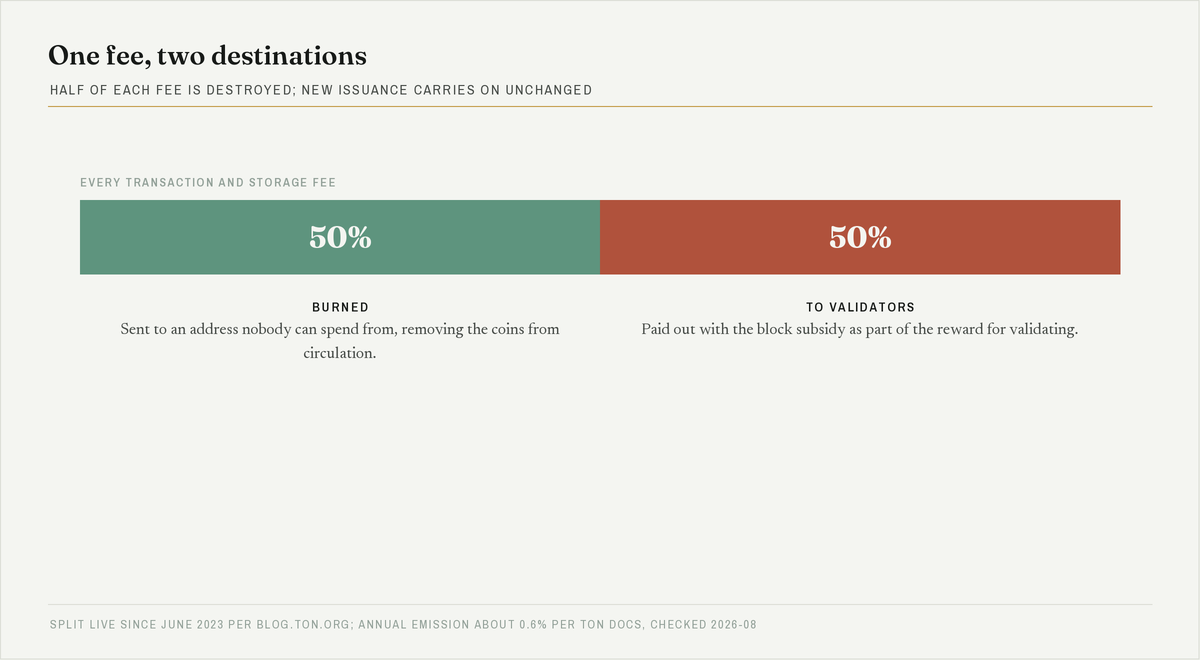
In June 2023, holders and validators voted for a deflationary mechanism, and it went live that month. Half of all transaction and storage fees are sent to an address from which they cannot be spent. The validator receives the other half.
The important qualifier, which the announcements state and summaries often drop: the burn affects fees only. The amount of newly issued coin is unchanged by it. So whether supply grows or shrinks depends on whether half the fee flow exceeds roughly 0.6% annual issuance, which in turn depends on how heavily the network is used.
Structurally this is the same two-sided arrangement as Ethereum's, with different proportions and a different burn base — TON burns half of both transaction and storage fees, where Ethereum burns a protocol-computed base fee and pays the tip to the proposer.
What it is actually used for
TON's usage profile is unlike anything else in this archive, because it is shaped by a chat application rather than by a trading ecosystem.
Telegram Mini Apps are small applications running inside the messenger, and a large number of them touch TON for payments, in-app assets or rewards. Some of the largest consumer applications in the entire industry by user count have run inside Telegram, including tap-to-earn games that onboarded very large numbers of people who had never used a blockchain before.
Beyond that: peer-to-peer transfers inside chats, which is the most natural fit for a messenger-native token; collectible usernames and anonymous numbers, which are genuinely novel on-chain assets; payment for Telegram advertising; and a decentralised finance ecosystem that is small relative to the user numbers.
That gap between users and financial activity is worth noting honestly. Very large user counts have not translated proportionally into on-chain value, and much of the game-driven activity was promotion-linked and did not persist at the same level once campaigns ended.
Risk checklist
- Platform concentration. Distribution depends substantially on one application. A change in Telegram's product strategy, ownership or policy affects TON in a way that no protocol decision can offset.
- Regulatory exposure through that platform. Telegram has faced legal and regulatory pressure in multiple jurisdictions. That is a live dependency for anything built around it.
- Original project was halted by regulators. The Telegram-run predecessor was stopped after US securities enforcement in 2020. The current network is a separate effort, but the history is part of the record.
- Validator concentration. Validation requires substantial stake, and the active set is not large.
- Activity has been campaign-driven. Large surges in usage have coincided with reward campaigns. Retention after those campaigns is the number that matters and is lower than peak.
- Distinct developer environment. TON does not use the EVM and has its own contract language and account model. That means fewer audited patterns and a smaller pool of experienced developers than EVM chains have.
- Supply direction is usage-dependent. With a 0.6% issuance and a fee-linked burn, net supply change is not fixed. It follows activity.
Where to buy
Toncoin is listed on major centralised exchanges, and can also be acquired inside Telegram through its integrated wallet, which is a genuinely low-friction route and also means an in-app custodial arrangement rather than self-custody by default.
If you use the in-app wallet, be clear about which mode you are in: custodial and self-custodial options exist side by side and the distinction determines who holds the keys.
The five billion initial supply and the end of mining in June 2023, the roughly 0.6% annual issuance, the per-block subsidy structure and the 50% fee burn live from June 2023 are taken from TON's own documentation and the TON blog's posts on the real-time burn proposal and vote, read August 2026. The 2020 enforcement action against the original project is public record.
Related: the other two-way supply mechanism in this archive · how TON's fees compare · supply structure table