You can hold a governance token for three years and never once have a vote. Nobody has to block you for that to happen. In most of these systems voting power is a separate quantity from your balance, it starts at zero, and switching it on is a transaction you have to send yourself.
Holding is not voting
Take Compound, whose contracts set the pattern most later systems copied. COMP is an ordinary ERC-20 with
one extra function: delegate. You call it with an address — your own, or somebody
else’s — and from that block onward your balance counts as votes for whoever you named. Before
you call it, the balance carries no weight at all. You can delegate to only one address at a time, and if
you later move the tokens the votes move with them.
Uniswap works the same way and says so plainly in its documentation: holders take part as delegates, and to vote they must first activate their voting rights by assigning them to an address.
Two consequences follow, and neither is small. The first is that coins sitting on an exchange are in the exchange’s wallet, so the address that could delegate them is the exchange’s, not yours. The second is that turnout figures read badly if you forget this. A proposal drawing votes from four per cent of the supply has not necessarily been ignored by the other ninety-six; a large part of that remainder was never switched on. This archive counts undelegated supply as simply absent. The chain records no difference between an owner who disagrees and one who has never opened the delegation screen, so reading either into the figure would be a guess.
The scope is a list of functions
The honest way to find out what a governance token governs is to stop reading the project’s mission statement and go looking for its admin functions. Governance can call those. It cannot call anything else.
Uniswap’s documentation gives the list in three lines: governance can spend funds from the treasury, set and activate the protocol fee, and mint additional UNI — up to two per cent of circulating supply a year. Read the wording carefully, though: the page introduces that list with “including”, which is documentation for “this is not necessarily everything”. A prose list is a starting point. The permissions written into the contracts are the actual answer.
Compound’s third version is more granular and the shape is identical. Parameters run through a Configurator contract: supply caps per asset, collateral factors, the slopes of the borrow and supply interest-rate curves, which price feed an asset uses, how fast rewards accrue. Each one is a setter function with the Timelock as its only permitted caller. Read that list and you know what a passing proposal can do, down to the argument.
What falls outside is often what people assume they are buying: the website and its interface, the company employing the developers, the trademark, the decision to keep building at all. A vote reaches the contracts. It does not reach the organisation standing next to them — roughly the same distinction the wrapped-token guide draws between a claim and the institution honouring it.
Two votes that share a name
Most large protocols run two voting systems and call both of them votes.
The first is off-chain. Holders sign a message with their wallet, nothing is sent to the chain, the whole thing costs no gas, and the result is a tally sitting on a website. It is real information about sentiment. It executes nothing.
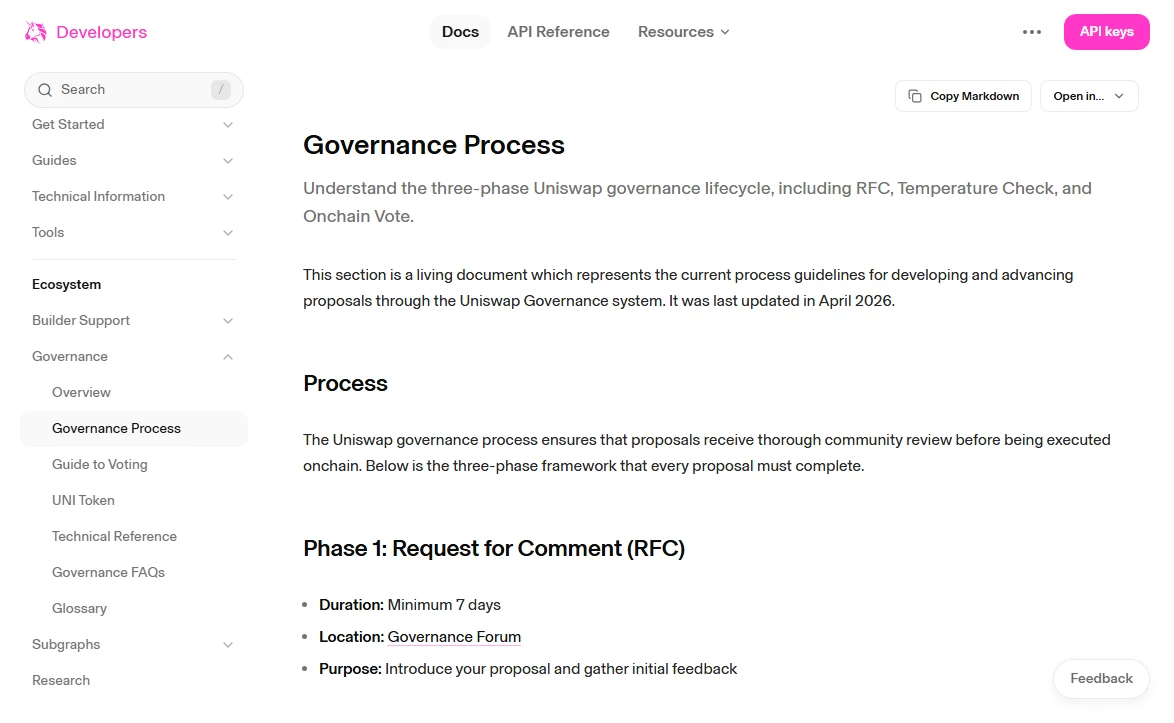
The second is on-chain. A proposal there is a bundle of calls to specific contracts, and when it passes it is queued and then executed exactly as written. Uniswap’s published process puts both in sequence with numbers attached at every gate: at least seven days of forum discussion; a five-day off-chain temperature check that needs ten million UNI voting in favour to advance; then the on-chain vote, which requires one million UNI delegated to the submitting address, waits two days before voting opens, runs for seven, needs forty million UNI in favour to pass, and sits two days in a timelock before anything executes.
Compound’s numbers are smaller and the rhythm is similar: 25,000 COMP delegated to you before you can propose, a two-day review, three days of voting, at least 400,000 votes in favour, two more days in the timelock. Its documentation adds the summary worth memorising — any change to the protocol takes at least a week.
Keep the two straight and one common disappointment stops being mysterious. When an off-chain vote passes and nothing happens, nothing was supposed to happen automatically. Someone holding a key, or a later on-chain proposal, had to carry it out. Whether that someone is obliged to is a question the token does not answer.
The clock, and who is allowed to skip it
The timelock is the best-designed part of these systems. Between a passing vote and its execution sits a fixed delay during which the queued transaction is public. That is the window where a careful reader can raise an alarm, and where anyone who dislikes the outcome can leave.
Emergency powers are the exception, and they are written into the same contracts. Compound has a Pause Guardian able to halt supply, transfer, withdraw, absorb and buy operations. The documentation is direct about who that is: token holders designate the address, and it is held by a community multi-signature wallet. A small set of signers can therefore stop the protocol in minutes, while the full governance process needs a week.
That is a defensible trade-off. Nobody wants to spend seven days voting while an exploit drains a market. But it is the part of the system your token does not reach on any ordinary day, and if you are working out what a governance token actually is, the emergency powers belong in the answer as much as the voting weight does.
When voting power can be borrowed
On 17 April 2022 an attacker took roughly a billion dollars in flash-loaned assets, converted them into a majority of Beanstalk’s voting power inside a single block, used that majority to pass a proposal sending the protocol’s funds to an address they controlled, and repaid the loan before the block closed. The protocol lost about 182 million dollars. The vote was valid. Every rule was followed.
Two design choices prevent the repeat, and both are now standard: count voting weight as it stood at a block in the past, so tokens acquired after a proposal exists cannot vote on it, and keep a mandatory delay between passing and executing.
The second failure mode is subtler. On 20 May 2023 the Tornado Cash governance contract was taken over through a proposal whose deployed code did not match the code the community had reviewed. Once it passed, the attacker held over a million votes and control of the governance contract itself. Voters had approved a description. What executed was calldata.
That gap is why simulation tools exist at all. Uniswap’s documentation notes that its two main voting interfaces have integrated one, which replays a proposal’s calldata and shows the state changes it would produce. If an interface offers you a simulation, that is the part worth opening; the prose above it was written by the proposer.
Four things to establish first
Before treating a token as a governance token, get four answers out of the project’s own documentation. An explainer, this one included, is a summary of what somebody read there on some earlier day.
- The contract addresses of the governor and the timelock. Without those, every claim about governance is unverifiable.
- The list of admin functions those contracts can call. That list is the whole scope of the vote.
- The proposal threshold and the quorum, read against how the supply is actually distributed. A quorum below what one large delegate holds is not a quorum but a formality, and the supply and emission guide covers how to find the distribution.
- The emergency powers. Who can pause, freeze or upgrade without a vote, and how many signatures that takes.
None of this says whether a governance token is worth holding, and this archive does not answer that for any asset. It says what you would be holding: a conditional right to submit and approve calls to a named set of functions, subject to thresholds, delays, and a set of powers sitting outside the process entirely.
Primary references
- Uniswap governance overview for the three controls governance holds and the delegation requirement, and the governance process page for the phase durations and thresholds.
- Compound governance documentation for the delegate function, the 25,000 COMP proposal threshold and the 400,000-vote quorum, and the Compound III governance reference for the Configurator parameters and the Pause Guardian.
Thresholds and durations here were read from the two projects’ own documentation in September 2026; the Uniswap process page recorded April 2026 as its own last update. The Beanstalk attack of April 2022 and the Tornado Cash governance takeover of May 2023 are public record, and the figures given for them come from published incident reports rather than from either project. Every number in this guide is itself changeable by the processes it describes, so read the current page before relying on one.