Whether a burn reduces supply depends on what actually happened. A burn function reduces an account balance and the contract total supply. A transfer to a dead address may instead change only what a data provider counts. A buyback is a purchase; any subsequent burn needs separate evidence. Check contract total supply, reported total supply, maximum supply and circulating supply separately: more than one can change.
What the burn function does to the number
Start inside the contract, since the authoritative figure lives there rather than in the announcement.
OpenZeppelin’s widely copied ERC-20 implementation documents a pair of mirror-image internal
functions. _mint creates tokens and assigns them to an account “by transferring it from
address(0)”. _burn, in the documentation’s own words, “destroys a value
amount of tokens from account, lowering the total supply”, emitting a transfer event with the
recipient set to the zero address. Both run through one shared handler, _update, described as
transferring tokens or alternatively minting or burning when the sender or the recipient is the zero
address.
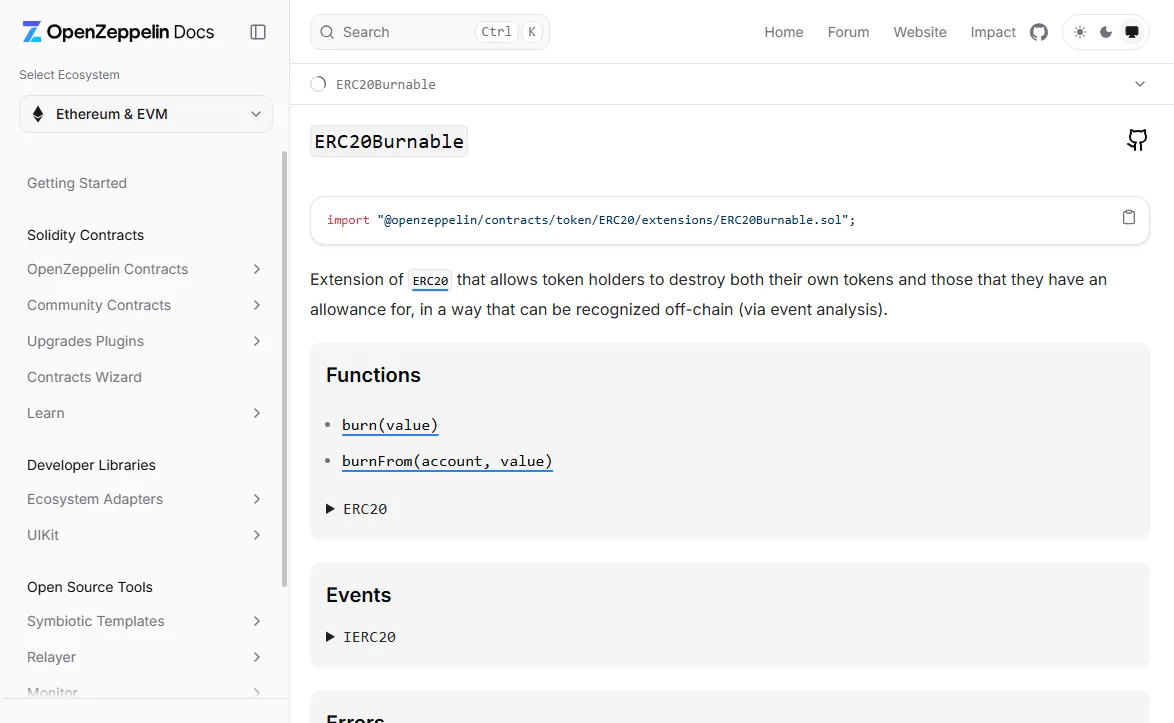
Holders reach that machinery through an optional extension, ERC20Burnable, which the library sums up as
destruction of own tokens. It exposes burn(value), destroying tokens from whoever called it,
and burnFrom(account, value), which destroys somebody else’s tokens and deducts the
amount from the caller’s allowance. One clause on that page deserves attention: the extension is
built so the destruction can be recognised off-chain via event analysis. Burns of this kind are designed to
be counted by strangers.
The call subtracts the burned amount from the account balance and totalSupply(). It does not guarantee that supply can never grow again. ERC20Capped checks the supply ceiling when minting; if minting remains available, a burn can reopen room below that ceiling. Check minting permissions and cap enforcement alongside the burn event.
The burn that leaves total supply untouched
Another method sends tokens to an address believed to be inaccessible, such as one ending in dEaD. If the contract treats this as an ordinary transfer, balances change but totalSupply() does not fall because of that transfer. An address pattern alone proves neither the absence of a private key nor the contract behavior. A dead-address transfer is also different from a transfer to the zero address: the standard OpenZeppelin ERC-20 implementation rejects direct transfers to zero.
A data provider can reach a different count. CoinMarketCap defines total supply net of verifiable burns, and its circulating-supply glossary discusses burns and inaccessible tokens. Neither count is necessarily a direct copy of totalSupply(). Dead-address balances and lost-key wallet balances can both remain in the contract, but the former has an observable transfer while the loss of a private key generally cannot be established from the ledger alone. Whether a provider subtracts either balance depends on its evidence and methodology.
A token without a burn function may still allow its holder to transfer to a dead address without upgrading the contract. The transfer still needs the sending wallet to authorize it, including multisig approval where required, and remains subject to token transfer restrictions. Before treating the balance as permanently inaccessible, check whether administrators can alter balances, upgrade the logic or migrate assets.
When the chain burns the fee itself
Ethereum moved the mechanism down a level. EIP-1559 introduced a per-block base fee that rises when blocks run above the gas target and falls when they run below, and the specification states the consequence in seven words: the base fee per gas is burned. No contract call, no treasury decision — the protocol removes the ether while processing the block, and the priority fee on top goes to whoever produced it. The ether record follows how that burn sits against issuance from the consensus layer.
The authors saw where the design pointed and said so. One heading in the specification’s security considerations reads “ETH Burn Precludes Fixed Supply”. Over a given period, the net change in supply is issuance minus burns; ending total supply also includes the starting supply. The burn depends on gas consumed and the base fee during that period. That reverses the usual direction of reading. Scheduled emission can be drawn years ahead, which the supply and emission guide works through; a usage-driven burn can only be observed after the fact, and a quiet quarter changes the answer.
Buybacks take tokens off the market, not out of existence
A buyback spends money — protocol revenue, treasury reserves, company profit — on tokens purchased in the open market. Two things follow that often get collapsed into one. The tokens now sit in a wallet the project controls, and the total supply inside the contract has moved by not a single unit. Whether they are later destroyed, redistributed to stakers, used to pay a team, or quietly sold back is a separate decision, taken later, by the same people.
Data providers have had to form a view on this. CoinMarketCap’s supply methodology notes that a number of revenue-generating projects execute public buybacks, that all bought-back tokens are unlocked, and that the industry consensus is nonetheless to leave them out of circulating supply — unlocked status, as the page puts it, cannot be the sole determinant of whether something circulates. The same document ranks four market-cap measures that differ only in which supply figure goes into the multiplication: fully diluted valuation uses maximum supply, minted market cap uses total supply net of burns, and the headline ranking uses public float.
So a programme described in a single paragraph may contain two events of very different permanence. The purchase removes tokens from the tradable float and can be reversed in an afternoon. A burn afterwards, if one happens, is the step that cannot be. BNB’s quarterly programme and the per-block fee burn underneath it are set out in the BNB record; the point here is narrower, that the two halves answer to different parties.
On a stablecoin, supply falls because the money left
Redemption of a fiat-backed stablecoin reduces token supply and the corresponding reserves as settlement completes. Circle Mint serves institutional customers and supports minting and redemption of USDC, EURC and cirBTC; USDC and EURC redeem one to one for dollars and euros respectively. Token processing and the bank payout are separate stages. An on-chain burn is not proof that fiat has already arrived.
Read as a scarcity event, that would be nonsense: with full reserves and redemption at par, reserve assets and the corresponding token liabilities decline together. That does not automatically improve reserves per remaining token. Supply changes reflect net issuance and redemption, but alone establish neither reserve quality nor future demand — which is why the supply structure table files stablecoin reductions under redemption rather than alongside the quarterly burns in the rows above, and why what backs the big stablecoins treats the reserve as the number to watch.
Checking one burn claim
Take a specific announcement and work through these five questions.
Where did the tokens go? In the OpenZeppelin implementation discussed above, a burn emits a Transfer event whose recipient is the zero address: 0x followed by forty hexadecimal zeros. A dead-address transfer may instead be an ordinary transfer that leaves contract total supply unchanged, while a data provider can adjust its count. Read the event, execution logic and supply changes together; the event alone is not a substitute for checking the code.
What does the contract say now? An explorer with contract-read support can query totalSupply(); convert the raw integer to token units using decimals(). Compare the relevant blocks before and after the burn, then check the dates and definitions used by the project and data provider. Differences can come from methodology, timing or concurrent minting, rather than necessarily indicating a neglected feed.
A percentage of what? One burn can be quoted against circulating supply, against total supply or against the maximum, and on a token with a large locked allocation those three denominators differ by multiples rather than by rounding. The same quantity of coins is then a respectable-sounding slice of the float and a negligible slice of the eventual maximum, both descriptions arithmetically true at the same moment. If an announcement omits its denominator, establish that before interpreting the percentage.
Where did the burned tokens come from? Fees paid by users, an unsold treasury allocation that never reached the public, or coins bought on the market with real money — each one means something different for everybody still holding, and the word burn on its own implies none of them.
Recurrence is the fifth question. Protocol burns follow the active rules, which can change through network upgrades. For a periodic project burn, check its commitment, execution history and stopping conditions. One completed burn guarantees neither another burn nor a price increase.
Primary references
- OpenZeppelin ERC-20 contract documentation for the behaviour of
_mint,_burnand_update, the ERC20Burnable extension withburnandburnFrom, and the ERC20Capped description of a cap enforced on total supply at mint time. - EIP-1559 for the burned base fee, the gas-target mechanism moving it, and the security-considerations heading about a fixed supply being precluded.
- CoinMarketCap supply methodology for the four market-cap definitions and the treatment of bought-back tokens, with the total supply and circulating supply glossary entries for the verifiably-burned wording.
- Circle Mint documentation for who can redeem USDC and EURC, and on what terms.
Contract behaviour quoted here was read from OpenZeppelin’s version 5.x documentation in October 2026, and tokens in the wild run many other implementations — the contract on the explorer outranks any library page, including the one cited above. Aggregator definitions and methodologies get revised without notice. No figure for any specific burn appears anywhere on this page, deliberately: those quantities move faster than an archive can keep them honest.