Every staking screen shows a percentage. Almost none of them show the sentence underneath it: those tokens have to come from somewhere, and on most proof-of-stake chains they come from two places only — supply that did not exist before, and fees somebody else paid to use the network. Which of the two is doing the work changes what the percentage means.
Two sources, and Cardano spells them out
Cardano’s documentation names both without hedging. Rewards, it says, are distributed each epoch and come from two sources: all transaction fees collected in the blocks minted during that epoch, and monetary expansion. The second term deserves unpacking, because the mechanism behind it is unusually legible. Ada has a maximal supply and a total supply; the gap between them sits in what the protocol calls the reserve. Each epoch a fixed, parameterisable percentage of whatever remains in the reserve is taken out, and that amount funds both the epoch’s rewards and a slice for the treasury.
Read that twice and the shape of the future appears. The draw is a percentage of a shrinking balance, so the absolute amount released per epoch declines over time even if nobody touches a parameter, and the fee share grows as a fraction of what stakers are paid while the reserve empties. The reward schedule and the emission schedule are one object seen from two ends — the supply and emission guide approaches it from the supply side.
Not every chain publishes the split so plainly. Where a project stays vague, the question to carry into its documentation is blunt: minted, or collected? A minted payout dilutes everyone who did not stake. A collected one moves value from users to validators and leaves the supply where it was.
Why the rate falls as more people stake
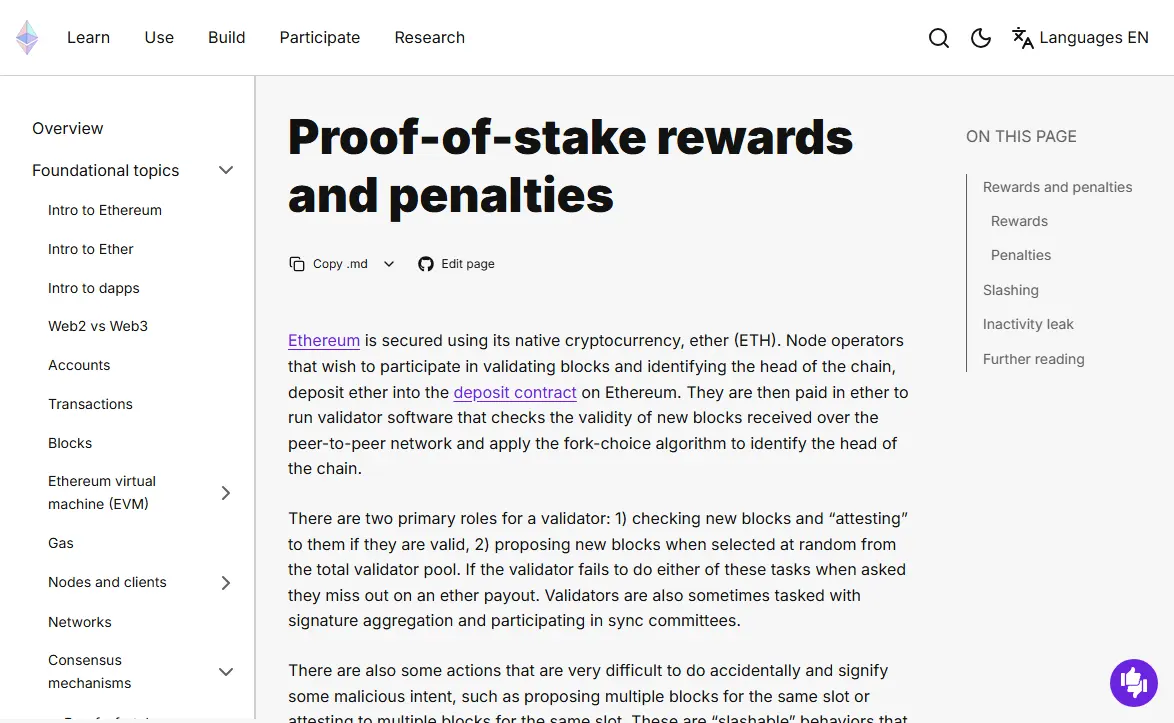
Ethereum pays from both pockets and separates them by layer. Consensus-layer rewards — for attesting, for proposing, for sitting in a sync committee — are newly issued ether. Execution-layer income works differently: the gas documentation states that the base fee of every transaction is burned, removing it from circulation, while the priority fee, the tip, goes to the validator. A proposer keeps the tips and the network destroys the rest. A headline yield for ETH is therefore a blend of fresh issuance and tips with a burn running underneath both; for that reason the ether record treats issuance and burn as a single question.
The issuance half has a property that catches people out. Ethereum’s documentation gives the
formula: a validator’s base_reward is its effective balance multiplied by
base_reward_factor, divided by base_rewards_per_epoch times the square root of
the total active balance on the network. The factor is 64 and the rewards-per-epoch figure is 4. The part
that matters is the square root in the denominator: total issuance grows with the square root of the
number of validators, while the reward reaching any one of them falls as one over that square root.
So the rate is a function of how many other people are doing the same thing. Quadruple the staked supply and the per-validator issuance rate roughly halves, with no announcement and nobody to appeal to. The documentation puts it in a line of its own: the more validators, the smaller the base reward per validator.
The payout itself is assembled from five weighted components — timely source vote (14), target vote (26), head vote (14), sync committee (2), proposer (8), out of 64. A validator neither proposing nor sitting in a sync committee is working toward 54 sixty-fourths of the base reward. That is the ordinary week, not the unlucky one.
The arithmetic a yield figure hides
Here the reward turns into a question about supply. Hold tokens and stake none of them on a chain that is issuing, and your share of the total falls by roughly the issuance rate. Stake and get paid at exactly the rate the supply expands, and your share holds level: more tokens, same slice. Only a net payout above the expansion rate grows the slice.
The comparison worth making runs between your reward rate and the rate at which total supply increases, rather than between your reward rate and zero. Suppose a chain expands supply by five per cent over a year while your net payout after commission is four. Your balance is larger and your share of the network is smaller than when you started. Suppose instead a chain has finished issuing and pays you one and a half per cent out of fees collected from other users: a smaller number, every unit of which is a transfer from somebody else rather than a fresh mint.
Those figures are arithmetic, not data about any particular asset — the real inputs sit on each chain’s parameter pages and they move. A yield quoted without a supply figure beside it is half a sentence. Solana publishes a declining schedule and the SOL record works through reading it against the staking rate; most chains publish something comparable, though rarely on the screen showing you the percentage.
What comes off before it reaches you
Three deductions sit between the protocol’s gross payout and your balance. Typically one of them is displayed.
Commission is the visible one. Whoever runs the validator — a pool, an exchange, a staking service — keeps a share, and the advertised rate may be quoted before or after that cut. Open the operator’s own fee page rather than the marketing figure, and check whether the percentage applies to rewards or to the principal; a commission on rewards and a management fee on assets diverge sharply over a few years. This archive keeps no table of provider rates, because they are changed at will and a stale table would be worse than none.
Penalties are the invisible one. On Ethereum, missing a source or target vote removes from your balance exactly what a timely vote would have added, so downtime costs twice its apparent price. Missing the head vote costs nothing extra, and failing to propose a block when selected carries no penalty at all — the reward simply never arrives. Slashing sits in its own category: for provably malicious behaviour such as signing two blocks for the same slot, up to 1 ETH is burned, the validator is removed over a 36-day exit while the balance drains, and on day 18 a correlation penalty lands that grows with how many others were slashed around the same time. Coordinated failure is punished harder than solitary failure, by design.
Capacity is the third, and a good deal of real-world yield quietly disappears into it. Cardano caps what a single pool earns: rewards rise with the stake delegated to a pool only until the pool reaches a saturation point, defined relative to a target number of pools, after which further delegation adds nothing for anyone already in it. Delegators who never check saturation are sharing a fixed reward with more people every week. Time is a fourth deduction if you count it, and most people should — a chain that makes you wait weeks to unstake is charging you an option on your own exit, which the DOT record covers where that wait is written into the protocol.
Three pages worth opening
Start with the reward section of the chain’s own documentation, hunting for the sentence that names the funding source. Cardano’s says fees plus monetary expansion in as many words; Ethereum’s hands you algebra and expects you to notice what sits in the denominator. Where a page states a percentage and never says where the tokens originate, the absence itself is the finding.
The parameter or supply page comes second, since a reward rate means little without an expansion rate to hold it against. Third, when somebody else runs the validator, read their commission schedule and their withdrawal terms in one sitting — together those two decide what you keep and when you can reach it.
No page will tell you whether staking is worth doing, and this archive holds no view on that for any asset. The mechanical answer is narrower and more useful: you are being paid, mostly in newly created supply, to keep capital committed and a machine behaving, and whether that leaves you ahead rests on a comparison the percentage on the screen never performs for you.
Primary references
- Ethereum proof-of-stake rewards and penalties for the base reward formula, the component weights, the penalty asymmetries and the slashing sequence, and the gas and fees page for the burned base fee and the tip paid to the validator.
- Cardano pledging and rewards documentation for the two reward sources, the reserve and monetary expansion mechanism, the treasury slice and pool saturation.
Formulas, weights and penalty rules here were read from the two projects’ documentation in September 2026. The percentages in the arithmetic section are illustrative and describe no particular chain. Reward rates, commissions and saturation parameters all change — often with no announcement, and in Ethereum’s case merely because more people staked — so check the figure on your screen against the current parameter page rather than against this one.