A liquid staking token is a receipt for ETH or SOL that a protocol has staked on your behalf, and the receipt is the part you can trade, lend or move. What it is a claim on differs by design: stETH represents a share of protocol-controlled ETH, with its balance recalculated after oracle reports; rETH and the Solana stake pool tokens discussed here keep the holding count fixed and reflect rewards or losses in the exchange rate. Getting the underlying coin back depends on a queue, available reserves or a market buyer. None should be treated as a promise of instant redemption at a fixed rate.
Staking without locking the coin up
Ordinary staking ties a coin to a validator. Ethereum requires at least 32 ETH to activate one. Since Pectra, validators using compounding withdrawal credentials can have an effective balance of up to 2,048 ETH; 32 ETH is no longer a fixed size for every validator. Withdrawals still follow the chain’s withdrawal and queue rules. Liquid staking protocols pool deposits and issue tokens in return, allowing individual deposits below the validator threshold, subject to each protocol’s own minimum. The ETH stays in the staking system; the token can be transferred.
That swap of one asset for another is the whole point, and also where the questions start. A receipt token has a protocol redemption value and a price someone else will pay today. Protocol rules determine redemption amounts and conditions; market prices also depend on supply, demand and liquidity. The staking rewards guide covers where the yield itself comes from; this page stays with the token.
Same reward, shown four ways
- stETH (Lido)
- Your balance is recalculated after oracle reports. Net rewards usually increase it, losses can reduce it, and reports can be delayed. One stETH normally tracks roughly one ETH of pooled stake.
- wstETH (Lido)
- A wrapper around stETH. Rebases leave the holding count unchanged; the stETH redemption rate reflects the value of the underlying shares.
- rETH (Rocket Pool)
- The count stays put; the rETH-to-ETH rate is recalculated roughly every 24 hours.
- Solana stake pool tokens
- Rewards leave the holding count unchanged; the SOL represented by each token changes with rewards, fees and losses.
Why can my stETH balance change without a transfer?
Because the contract never stored it as a fixed number. Lido records each holder’s position in shares — in its own words, “a basic unit representing the stETH holder’s share in the total amount of ether controlled by the protocol.” The balance a wallet displays is computed on the fly: your shares multiplied by the current ETH value of one share.
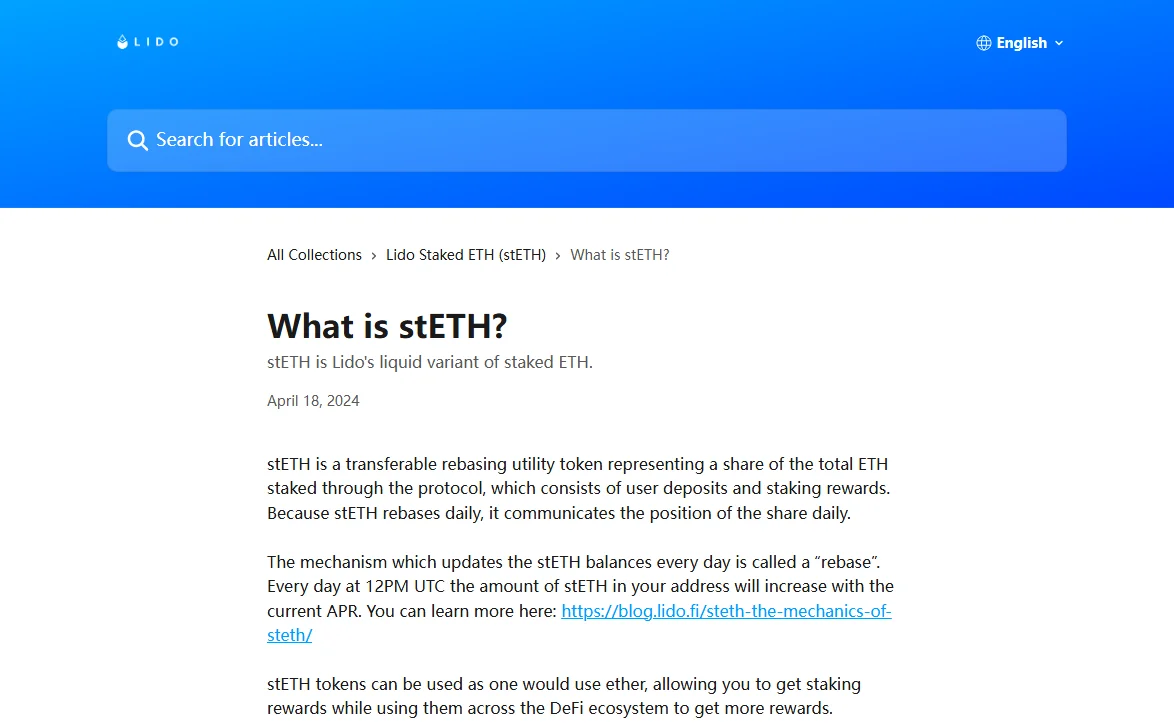
When Lido’s oracle reports the latest consensus-layer balances, the value of a share is recalculated and every balance shifts at once. The help centre gives a routine schedule of 12:00 UTC daily, but the integration guide lists delayed and skipped reports, so this is not a guaranteed appointment. The rebase itself sends no transfer to the wallet. The next balance query uses the updated share value: net rewards can raise it, while losses can lower it.
Two quirks follow from this design. Explorers and portfolio trackers that cache balances can lag behind the rebase; Lido keeps a help article titled “Why isn’t my stETH balance increasing on Etherscan?” for exactly that. And because shares convert to stETH through integer division, the integration guide warns that sending a whole balance can leave “the last 1-2 wei” behind — dust measured in billionths of a billionth of an ETH, enough to make a wallet that looks empty not quite be.
Lido’s integration guide lists a fee of 10% of staking rewards, split equally between node operators and the protocol treasury. Rewards reflected in the balance are net of that fee; this does not imply a positive return every day.
Plenty of DeFi software dislikes balances that change on their own. That is why wstETH exists: wrapping stETH gives you an ERC-20 whose balance “does not rebase”, with changes reflected in the stETH redemption rate instead. Same shares underneath, presented the other way round.
rETH keeps the count and moves the price
Rocket Pool chose the second presentation from the start. As an illustration, at a rate of 1 ETH per rETH, a deposit of 10 ETH gives 10 ÷ 1 = 10 rETH. With no transfers in or out, the count remains 10 rETH a year later. What changes is how much ETH each unit redeems for. The documentation gives an approximate update frequency of 24 hours. Accumulated rewards normally raise the ETH value per unit, but losses can reduce it; the rate is not guaranteed only to rise.
The ETH behind rETH sits in validators run by independent node operators. Under the current megapool design, a new validator pairs 4 ETH from its operator with 28 ETH from the deposit pool funded by rETH holders. Existing validators may have different bond arrangements. The documented minimum liquid-staking deposit is 0.01 ETH.
rETH bought on an exchange is the same staking position as rETH minted directly: every unit is interchangeable, so the token itself is the stake. Rocket Pool’s docs also note that a fixed token count can matter for tax in some countries, since holding alone creates no new units — a point to check against local rules rather than take from a protocol’s documentation.
Solana stake pool tokens work like rETH
This section covers pools using the stake pool program published in Solana’s program library; it does not extend those rules to every Solana liquid staking product. Depositors receive SPL tokens representing fractional ownership of the pool. Net staking rewards increase the SOL represented by each token. Rewards are accounted for by epoch and reflected in the rate when the pool is updated, rather than through continuous automatic growth. Fees and losses still matter.
The pool manager takes a percentage of rewards each epoch as a fee, set per pool. The documentation also attaches a condition to its promise that holders can always withdraw: “unless the pool tokens are frozen.” Whether a given pool token has a freeze authority set is readable on its mint account, the same field described in what a token standard defines.
Getting ETH back: queue, pool or market
Every liquid staking token has two prices: what the protocol pays on redemption, and what the market pays right now. They usually sit close together. Nothing forces them to.
Lido’s exit is a queue. A request locks stETH in the withdrawal queue and gives you an unstETH NFT, an ERC-721 token representing the claim. Request limits are 100 wei of stETH to 1,000 stETH. The help centre’s withdrawal FAQ gives a routine wait of 1–5 days, which can extend in exceptional conditions; it is not an arrival guarantee. The final ETH amount is determined at finalization. The stETH submitted at request time caps the claim, rather than fixing the eventual payout. Queued tokens earn no further staking rewards but remain exposed to losses.
Rocket Pool’s exit is a pool. You can burn rETH for ETH directly, but only while the deposit pool holds enough unstaked ETH to cover it. When operators have put it all to work, the documentation sends holders to decentralised exchanges, “though they will likely come with a small premium”.
Solana pools offer two doors: withdraw SOL if reserves are sufficient and the pool’s SOL withdrawal authority requirements are met, or withdraw an activated stake account under the program’s rules. The stake account must then be deactivated and finish unstaking before its SOL can be spent.
A secondary-market sale can avoid the protocol’s withdrawal queue, but execution and the price still depend on buyers and liquidity. In June 2022, before Ethereum’s 2023 Shapella upgrade enabled staking withdrawals, stETH had no protocol redemption route and traded below ETH on secondary markets, as Coinbase’s institutional research analysed that month. With redemption available, buying below redemption value and redeeming can narrow a price gap, but waiting times, costs and risks limit the trade. Without redemption, exiting depends more heavily on market buyers.
When the staked coins shrink
Validators can be penalised, and in a slashing event lose part of their stake. Holders bear losses that reach the assets backing their liquid staking tokens; where a protocol has operator collateral or another buffer, it can absorb losses first. Net losses can reduce a stETH balance or lower the redemption rate of rETH and pool tokens. Lido’s documentation also notes that withdrawal requests can be finalised below 1:1 if losses are too large for daily rewards to cover. The claim is on the assets accounted for by the protocol, never a guarantee of a fixed amount of ETH or SOL.
Rocket Pool puts a buffer in the way: the operator’s own ETH bond absorbs losses before depositors’ ETH. The current bond for a new megapool validator is 4 ETH; that amount should not be assumed for all existing validators. The bond can cushion losses reaching rETH holders, but cannot eliminate them.
Above validator risk sits contract risk — a bug in the staking contracts would reach every holder — and the governance arrangements that control upgrades. The governance token guide goes into what a token vote can and cannot change.
Documents read for this page
- Lido tokens integration guide for shares, the rebase, wstETH, the 1–2 wei note, the 10% fee split and withdrawal request limits; WithdrawalQueueERC721 for queued requests earning no rewards and below-1:1 finalisation.
- Lido help centre articles “What is stETH?” for the routine rebase schedule and Ethereum withdrawals FAQ for the routine 1–5 day range and possible delays.
- Rocket Pool staking overview for the rETH rate, its update frequency, the 4 ETH megapool bond, the 0.01 ETH minimum and the deposit-pool exit; the protocol FAQ explains how operator collateral cushions losses passed to rETH holders. Its legacy validator amounts should not be applied to new megapools.
- Solana stake pool program documentation for fractional ownership, the epoch fee, the freeze condition and the two withdrawal routes.
- Ethereum.org on MaxEB for the 32 ETH activation minimum and the 2,048 ETH maximum effective balance for compounding validators.
- Coinbase’s June 2022 stETH price-divergence research for the historical example.
Loss allocation in the linked Lido and Rocket Pool documents was rechecked on 16 October 2026. The documents and research linked above were checked again on 15 October 2026. Fees, limits, bond sizes and withdrawal conditions can change. Protocol figures here record that documentation check; they are not promises of returns or arrival times. Check current protocol rules before acting.